○
Great Beautiful Empty
On the beauty of voids, edges, and the spaces between
Begin now · 22 chapters at your pace
22 chapters · daily, every 3 days, or weekly · your choice
Each chapter unlocks on your personal clock. You can read at your own time, return to earlier chapters whenever you want, and shift pace whenever you like.
Sign up for the weekly notes and we'll email each chapter to you the moment it unlocks.
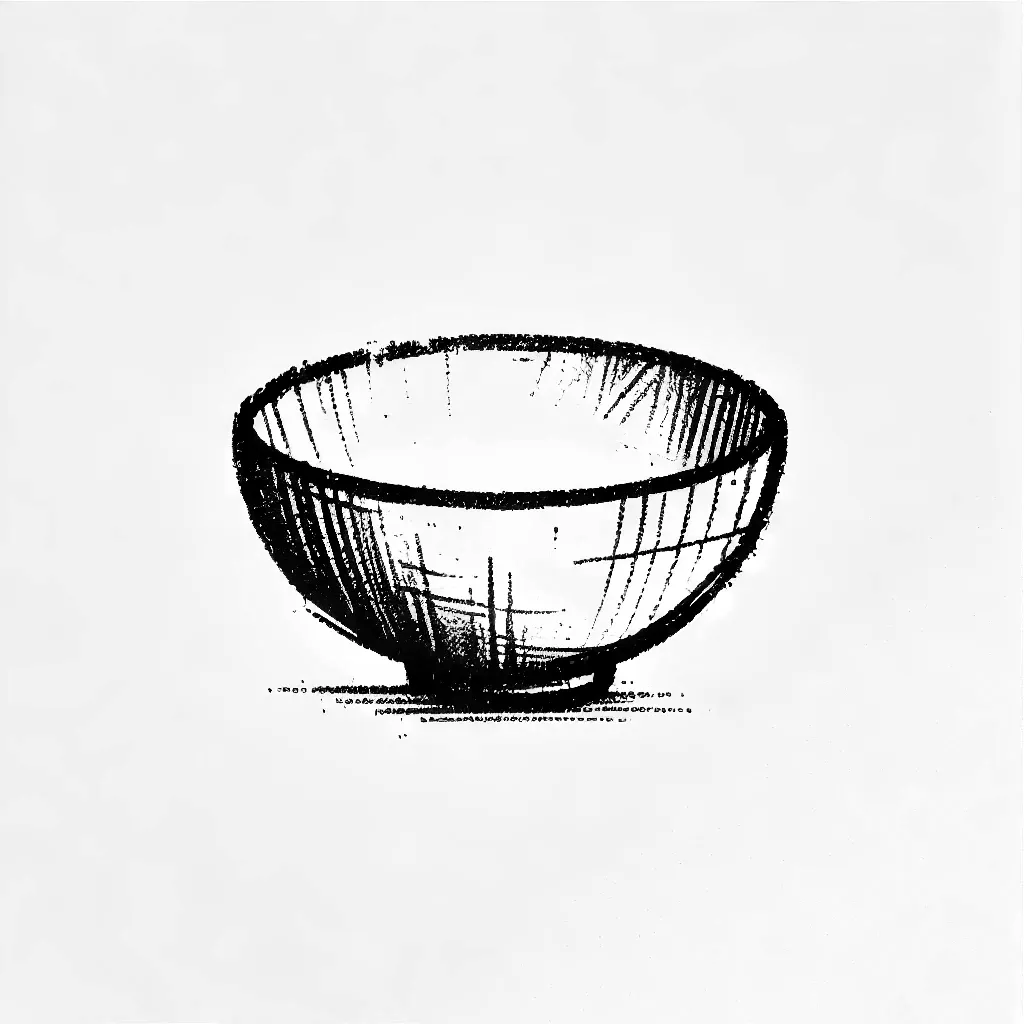
The bowl's emptiness makes the bowl. A whole and a hole. Wrap clay around a pocket of air, and you have made something that can hold. Without that hollow, you have a stone.
Dark spaces make beauty visible. Shadow holds it. The breath between one note and the next carries it.
A bowl waits — for water, for soup, for the weight of an offering. Or for nothing at all. A string of silences becomes a song. A blank page becomes a sonnet.
The hour between day and night flickers like shadow on a wall. You may find stillness there. A clearing where reflection pools. Space found, space made.
In the middle places, things show themselves. Neither sharp at noon, nor lost at midnight. Fleeting in-betweenness, defining and defying explanation.
We don't have a word for the beauty of quiet betweenness. The courtyard with its open square. The breath caught at parting. Notice that the candle's flicker is more beautiful than the bulb. Empty transitions hold the moment when something becomes clear.
Don't chase the false certainty of the fully formed: the packed schedule, the rushed errand. Real wealth is hours to stare at the sky as it disappears.
What's not said. What's not finished. The confidence to let enough be enough.
Leave room. In your day, in your attention. Leave room for others, and for what hasn't arrived yet. Things unfold in their own time. Time itself is empty on either side of you. Only this thin sliver of now feels real.
To leave room for someone is already to love them. It does not need saying.
That startled feeling of staring into a vast empty — the catch in the breath, the widening eye — that is the growing itself. From the still center outward to grey edges, where new forms wait without names.
The bowl, defined by its nothing. You carry many such voids: ahead, beside, behind. The dark you have not entered yet is sometimes only a room.
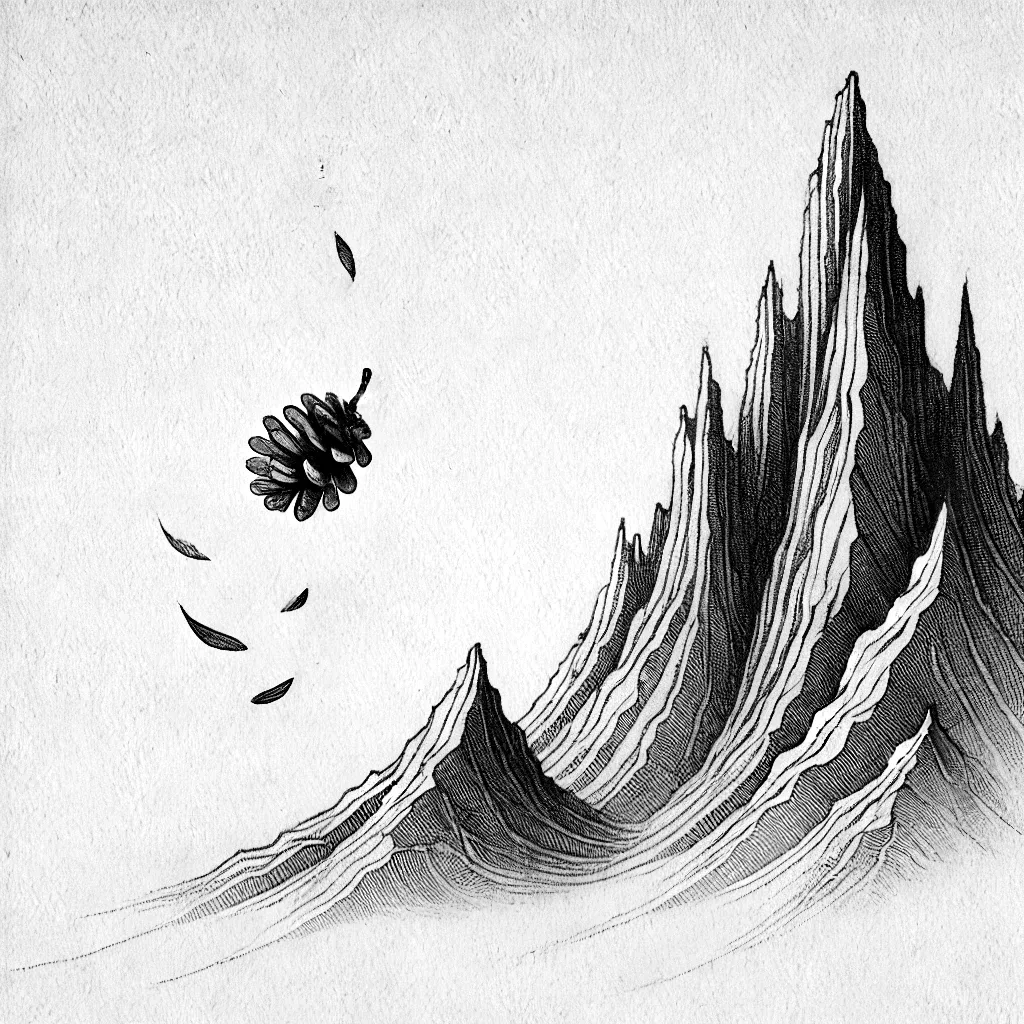
The Mountain is Empty;
A Pinecone Falls;
Zekkai Chushin
Five empties hide in those few words. The sky the mountain holds. The silence before the pinecone strikes. The seed's unborn forest. And your mind, empty enough, just now, to receive them all.
Some empties have names. Those are the ones that teach us most.
Beauty hides in spaces overlooked. Wisdom in the boundaries that separate and join.
Plato's cave gave us the chance to imagine. So does this.
You are invited into empties, beautiful and terrifying. The faint line where sea melts into sky. The moment when silence gives birth to sound. Edges. Boundaries. The poets of our reality.
Empties speak in whispers, in the language of transition and what has not yet formed. They make room for change. Or for failure.
The perfect is brittle. Already filled. No room for growth. The imperfect has potential. Given enough time, all is imperfect. And the imperfect is what we love.
Imperfection is a gift; it leaves room for process. The worn knife has more stories than the new blade.
Totalitarian perfection crushes. It fills every gap with the weight of declared truth. Brutalist concrete does the same in stone, forcing out the small voids where growth and harmony once breathed.
The noisy and broken system allows for change, for discovery, for adaptation. The Apollonian only makes sense beside the Dionysian. A timeless castle in the forest needs the encroaching forest. Time reveals all to be messy and broken. Wholes become pieces as the empty of time reshapes them. For a while, the sublime shines.
A shadow's edge moves silent and unnoticed across a tatami floor each day. A half-formed thought lingers at the rim of consciousness, not quite grasped but felt. These need patience. These need space.
The edges of empty give form to the formless and voice to what cannot be said. The gnarled border of what we almost-know is where creativity dances. Follow it.
What follows maps those edges. Where the cell wall meets the void. Where the equation dissolves. Where the brushstroke fades to bare canvas. Quiet gaps that hold both possibility and dread. We go there now.
The edges of empty are where life's most active exchanges happen. The yin-yang, turning. Thing into non-thing. Returning.
Notice how the artist uses negative space. Worlds within worlds. Imaginations held in place. Leonardo's sfumato. The white of a haiku. The pause in a piece of music. The unsaid often speaks the loudest.
As we cross into voids, learn to feel the half-tones of experience. Look for the soft transitions between what was and what will never be.
Chase ambiguity. The unspoken. The unthought. A whole life has many holes.
Here, in the gradients between extremes, the small cracks where beauty gathers and quiet insight waits.
Like ma — the meaningful space between things.
A world that demands certainty builds walls where doors should be. Praise shadows instead. Blurred lines. The voids and ambiguities that make a life worth feeling.
Mystery brings meaning the way awe brings waking.
Soften your gaze. Quieten the mind. Let go. Judge slowly. Think more slowly than that.
Noise is the great fury. The serenade of the signal is a scintilla.
To hear the great empties, to feel their edges, is to come to know yourself: a being in the continuous state of becoming, poised on the seam between what was and what may be. Process unfolding. Forms reshaping toward the void.
Welcome, reader, to beautiful empties.
Move now into the twilight of understanding. Each ending drifts gently into a fresh beginning.
Every boundary is an invitation.
This chapter unlocks on your own clock — based on the pace you chose. Sign up for the weekly note and we'll email it to you the moment it's ready.
Sunlight strikes a lake and shatters. Neither water nor light, the surface trembles — a boundary that refuses to be one thing. Watch it long enough and what seemed definite dissolves. This is where transformation lives: at the edge of perception, where solid softens and certainty gives way.
The shimmering edge is not a line. It is a state of becoming. The held breath between what was familiar and what has not yet taken form.
Fog at dawn touches the mountain. Solid earth, empty sky, and between them a wavering between worlds that will not hold still. Shimmer lives in movement. Never returning to what was. Never revealing what comes. Present and dissolving at once.
Perception lives in shimmer. The mind cannot hold it. Reach, and the light slides through your fingers. What you see and what exists oscillate, each feeding the other, neither winning.
Evolution knows this shimmer. Life does not advance in smooth lines but in bright bursts between long silences. The edge of what a species is and what it might become vibrates with potential — pregnant with future forms, still tethered to the past.
At such thresholds, new forms surface from what looks like nothing. Consciousness rises from a web of firing nerves. A society rises from chance encounters between strangers. Love rises from two people in a room. Not gradual slopes. Leaps.
Where solid meets liquid. Where order meets chaos. Where simplicity gives birth to complexity. The most astonishing phenomena occur exactly here. Not absences. Crucibles.
Artists have always known this. Monet's water lilies hold the space between water and light — a formed line dissolving into an imagined edge. You don't merely see the painting. You enter the shimmer.
In music, the gap between harmony and dissonance holds the trembling. Jazz thrives there. The expected pattern dissolves. The bent note opens a door the composer never drew.
Between two people, not fully separate, not yet merged, a clearing opens. Not in possession. Not in distance. In the middle, where mutual becoming has no name yet.
The digital world has cracked open new edges. Virtual bleeds into actual. Identity turns liquid. Presence slips free of place. From these voids new forms of community swim upward, like creatures sensing light for the first time.
Consciousness itself is a shimmering edge — the space between matter and meaning. The past fades from us in pinpoint moments, each one a passage. Awareness dances in this void, neither purely physical nor metaphysical. A vibrating act: matter becoming meaning on a stage no one built.
Don't treat uncertainty as a problem to solve. Treat it as the place wonder is born. Plato was wrong to huddle in his cave. The shimmer on the wall was never a flaw in understanding. It was the first signal of everything worth perceiving.
In these undefined spaces — not fully one thing, not the other, not complete, not void — the universe innovates. Evolution happens here. Art happens here. Connection deepens here. The universe wakes up, briefly, to see itself. What it sees is beautiful.
To live fully is to dwell at the shimmering edge. Hard certainties cannot hold the deepest truths. Those truths show themselves only when you learn to see, hear, and feel the subtle trembling at the edge of everything.
This chapter unlocks on your own clock — based on the pace you chose. Sign up for the weekly note and we'll email it to you the moment it's ready.
What you hold is not a book. It is a cartography of absences, the atlas nobody drew because the territories keep dissolving under the surveyor's feet. Good. That is how you know the map is honest.
Turn these pages as you would enter a cathedral at dusk. Slowly. Let the pupils widen. What sharpens first are edges, where art bleeds past its frame, where silence gathers mass before the conductor's baton falls.
A thought crystallizes from unconscious mist. A pen crosses paper and inscribes the frontier between stillness and verse. These margins give form to the formless. The skeleton emptiness wears to be seen.
You will stand in galleries where paintings refuse their borders. You will stand in concert halls where the rest between notes holds more gravity than the chord. You will find economists staring at value the way desert travelers stare at heat shimmer, convinced it is water, unable to stop walking toward it.
Science appears too, though not as fact. Science is pursuit, not possession. A net flung at fog, tightened, drawn back glistening and empty. The ledge of the known holds us while the unknown gazes back, not hollow, but bright with possibility.
Each reading rearranges the map. That is not a flaw. A chart that never changes describes a dead landscape. Let the borders migrate. Let whole provinces of certainty sink beneath new coastlines of doubt.
Observation itself is an edge. To look is to alter. Memory fills a shape, then fades, and the shape left behind is never quite the same. Cities of thought rise, erode, rise somewhere else. Time has margins too, and they blur past into future like watercolor left in rain.
At history's fault lines, epochs collide and cultures merge. New identities crystallize from fragments of shattered ones, the way stained glass is lovelier for having once been sand. In the distance, whole horizons vanish. Species. Languages. Entire ways of knowing flicker out like the green flash at sunset. The shape left behind is never nothing. Where one horizon drowns, the next lifts itself into view.
At the borderlands of mind, conflict and cooperation share a root. Stagnation and revolution drink from the same well. Ancient hands carved gods from stone. Modern hands pour concrete for banks. Both acts are prayers to the future self, funded by longing.
Charting these territories, you may find yourself the strangest edge of all. Caught between animal and something almost divine. Between stardust and the consciousness that learned to name the stars. To feel the empty is to sense the multitudes you contain, beings in flux, poised at the brink of becoming.
So step into this twilight cartography. Praise the shadows. Praise the undeciphered, the blurred gradient, the ambiguity that thickens rather than thins your life. The most elusive beauty gathers in the gentle slope between extremes, and the deepest insight sleeps there with one eye open.
Now turn the page. Every boundary, an invitation to cross.
This chapter unlocks on your own clock — based on the pace you chose. Sign up for the weekly note and we'll email it to you the moment it's ready.
In the hush between heartbeats, you find yourself. Not in fullness. Not in void. In the sigh before the word forms.
Come.
Where sea meets sky, the line is barely there. Where silence gathers weight, the moment slips before you can hold it. These thresholds make the world.
A shadow's edge crosses a wooden floor. A thought lingers at the rim of knowing. Here the formless takes form, and silence lends the unsayable a voice.
We will wander galleries where paint refuses its frame, and concert halls where silence opens into song before darkening back again.
We will stand at the lip of revolutions. Value trembles. Mirage or oasis, no one knows until the thirst is slaked or isn't.
In the long story of science, you teeter. Knowledge is a ledge beneath your feet. The unknown is a pit that, looked into long enough, looks back and blinks first.
From the crisp edge of a proof to the blurred margin of a poem. Apollonian precision gives way to Dionysian roar. The charged silence between is what we are after.
It defines and defies.
Step between. Praise shadows. Celebrate what refuses to resolve.
In the gentlest gradients, between inhale and exhale, between knowing and wonder, beauty without a name gathers. The deepest insight never fully arrives.
Fear and excitement share a single nerve. The face of the unknown wears both masks at once.
This is the choosing. Across many terrains, you go looking for what the filled world cannot hold.
Turn the page. Step into the empty. Let it fill your wonder. Let it empty what you knew.
You are a vessel. The space that holds you open is what makes you one.
This chapter unlocks on your own clock — based on the pace you chose. Sign up for the weekly note and we'll email it to you the moment it's ready.
Hold a razor to the light. That gleaming line where steel ends and air begins, you would call it a boundary. Clean. A world on each side.
Lean closer.
Under magnification the edge breaks into terrain. Atoms arrange themselves in ridges and valleys no hand intended. What seemed a single clean cut is a country of its own, neither blade nor air but something unnamed that belongs to both.
This is what sharpness conceals. Not separation. Convergence. The thinnest place where one substance is still learning to become another.
Molecules at the precipice hold dual citizenship. They vibrate between allegiances. The old identity has cracked. The new one has not yet hardened.
Every edge you have ever touched was this: a bridge dressed as a wall.
The edge of a person is felt most sharply when they step across it for the last time.
Draw a line and call it a border. The border is not empty. It is the most crowded place in the geometry, endings and beginnings sharing the same address, neither willing to leave.
Fog rolls across a hillside. The tree line was certain an hour ago. Now it is a suggestion the meadow half-remembers.
Where does the forest stop? Point to it. Your finger finds only gradation. Bark fades into mist. Green dissolves into grey. Solid ground becomes cloud. Definition itself has gone soft at the seams.
This is not a failure of perception. The world is confessing what it always was.
A coastline at high tide is not the coastline at low tide, yet we give it one name and pretend it holds still. The shore is a verb, not a noun.
In the blur, imagination wakes. What was rigid loosens. Certainty, that brittle currency, depreciates, and something richer circulates in its place.
When the fog arrives, do not reach for clarity. Walk further in.
A prism splits white light, and between each hue lies a threshold that belongs to neither color. Not quite red. Not yet orange. A gap the eye cannot fix in place.
Some edges cut like glass. Others breathe like morning haze. Most flicker between, tracing a gradient from crisp to blurred.
Consider language. A word precise as arithmetic softens into poetry the moment context shifts. Between denotation and connotation, meaning does not sit still. It migrates.
Or music. Staccato strikes give way to legato phrases. In the silence between notes, rhythm breathes. A melody slips between genres, and that no-man's-land of sound is where new forms harden into shape.
Even science, long champion of clean partition, bows before the in-between. Quantum superposition refuses either/or. Both/and is the deeper grammar, and from it bloom theories that neat categories could never have conceived.
The sharply defined seldom births the radical. Fuzzy borders do that, where biology tangles with technology, where art and mathematics forget which one arrived first.
So when you encounter a boundary, look closer. Past the line, past the blur, into the territory where potential has not yet chosen its shape.
That territory breathes the future into being. Already it is beautiful.
This chapter unlocks on your own clock — based on the pace you chose. Sign up for the weekly note and we'll email it to you the moment it's ready.
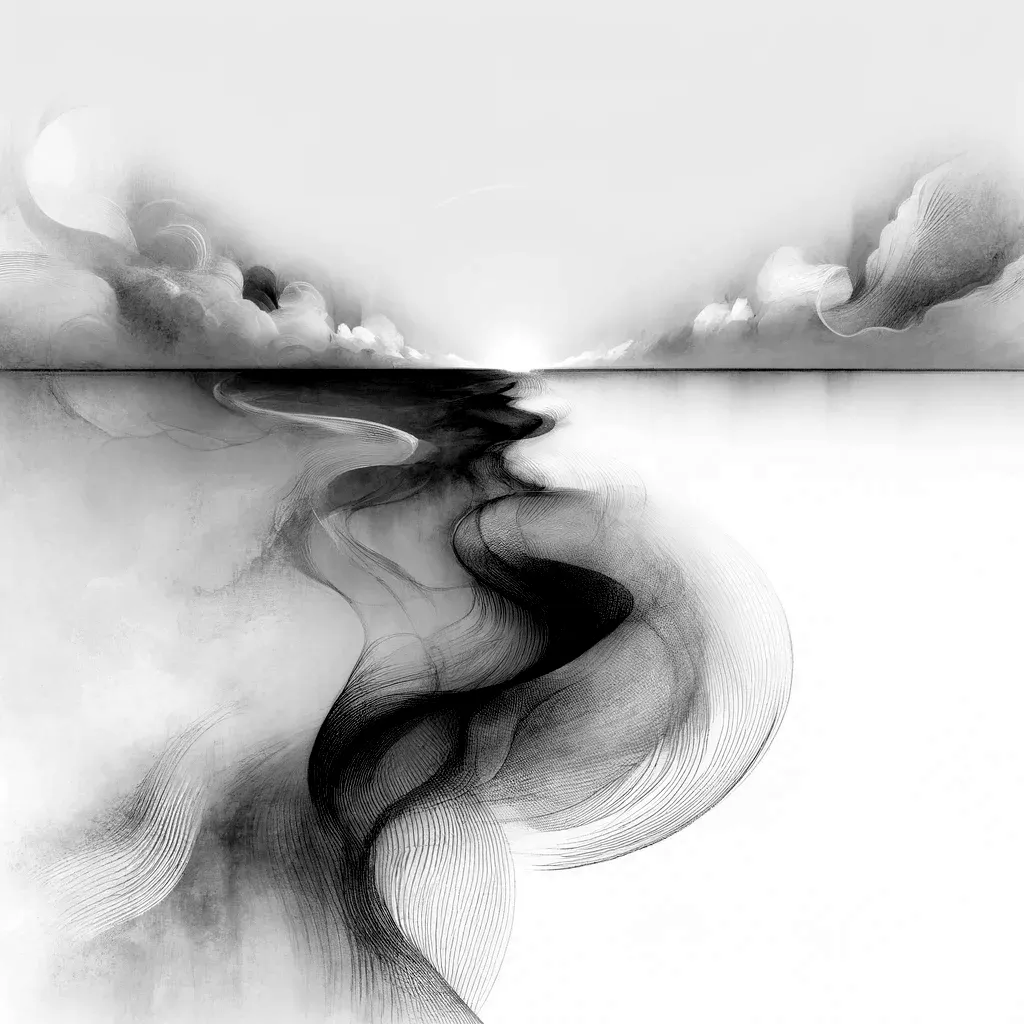
The horizon stretches before you, a mirage of possibility. Always seen, never touched. A void whispering of worlds beyond. What compels you to chase it? To sail toward an edge you cannot reach?
The promise of unknowns. Blank spaces on the map.
In ancient times, we filled the gaps with dragons. Serpents coiled at the torn edge. We still draw monsters there. Now we call them dark matter, exoplanets, the silence between signals.
The void drives us. It builds the ships and grinds the lenses. The gap itself propels us. Ignorance is the explorer's first fuel.
Between what you know and what you ache to understand, a space hums. It shapes the myths. It sharpens the sciences. It haunts your sleep.
The clearing at the horizon birthed explorers. The space between notes gave us music. The silences between words gave us poetry.
You are defined not by what you know but by what you chase. The pursuit of emptiness moves the soul forward.
To uncharted seas. Across continents. Off to distant stars. Into each other.
Each horizon reached reveals another. Each void filled uncovers new ones. Each threshold crossed births more.
So we continue. Restless. For in the pursuit, you discover not just new worlds, but yourself.
We are the species that dares ask: what lies beyond?
Look to the line where sky meets sea. That shimmer holds more of you than any certainty does.
Stand at the water's edge. One foot on sand, one in surf. Two worlds collide in the gap, and you stand at the seam.
Neither land nor sea. A changeling shore, alive at the threshold of both.
Tides reshape the edge without rest. Waves erase footprints. New ones form. Life adapts here, in this shifting zone. Not a line drawn on a map. The place where creation does its fiercest work.
In tidal pools, ecosystems flourish in miniature. On shifting sands, pioneering plants take root. In brackish waters, species transform to bridge two worlds.
You are drawn to these thresholds. Ports rise as gateways between land and sea. Cultures blend where sailors and shore-dwellers mingle, trading tongue and spice across the dock.
Mountain ranges where lowland and highland species intermingle. River deltas where fresh and salt water meet. Desert edges where arid and fertile lands negotiate a truce measured in millimeters of rain.
These transition zones are nurseries. Not gentle ones. Nurseries where departure and arrival share a single bed, and survival is measured in millimeters of root.
The borders we draw ourselves are collective fictions, scratched across land and peoples. Lines that exist only because enough people believe in them.
At these borders, cultures pour into one another. Languages blend, birthing dialects. Cuisines fuse, inventing flavors. No culture was ever fixed. Each is a chorus of stories layered over centuries, flowing like streams through every generation. No one owns the song. It sings us all.
Yet these edges cut both ways. Conflict and cooperation coexist. Change wrestles tradition for the wheel.
That tension sparks. Innovation follows.
You cross a void when you step from the familiar into the unmapped. The known falls away. The possible rises. Listen for it.
Drift in the haze between sleep and waking.
A clearing where dreams whisper to reality. Where the unconscious minds the conscious.
You are always becoming, never quite arrived. Suspended between past self and future self like a trapeze artist mid-arc, belonging to neither platform.
In this threshold, transformation brews.
The rigid structures of the waking mind soften. Possibilities bloom in the soil of uncertainty.
Here, in this twilight of identity, you glimpse who you might become.
Old fears dissolve as morning mist. New strengths crystallize like dew on grass.
A crucible of personal alchemy. Painful experience becomes wisdom. Challenge becomes resilience. The heat does not ask permission.
In liminal spaces, creativity ignites. Freed from the constraints of should and must, the mind wanders unexplored paths. The strange country of may and might.
And as you linger in the void, you learn to sit beside discomfort. Not to solve it. Just to be in the room with it.
Tune into the gaps between certainty, and you discover your deepest truths.
Cherish doubt. It is the mind in labor, preparing to deliver something it cannot yet name.
In these gaps you craft the self. Not once, but endlessly.
Like the chrysalis. That bright dissolve. The becoming needed the uncertainty to emerge transformed. There is no thing, only shimmering process.
You are more than your story. Who you were is less than the awaiting of who you will be.
You are empty in between. A living, breathing possibility poised at endless now, looking out.
The gap between who you were and who you will be grows you. Nowhere else does.
A chrysalis hangs from a branch, still as stone. Inside, nothing that was remains. Nothing that will be has arrived. The between holds everything.
That hush — a split second of pure potential — echoes through the sensory world.
Listen closely to a piece of music. Between each note, a micro-silence exists. Not absence, but anticipation. The held breath before the next tone.
In these spaces, your mind leans forward. Activated as participant, not passive listener. Expectation mingles with memory. The note that was colors the note to come.
Take a sip of complex wine. As it rolls across your tongue, flavors bloom and fade. Fruit gives way to oak, sweetness to tannin, each transition a threshold of taste where the palate recalibrates and learns to name what it could not name before.
Gaze at an optical illusion. At first, a jumble of lines. Then, in a flash, the hidden image reveals itself.
That instant of revelation, the clearing between confusion and clarity, reshapes perception. You cannot unsee what you have seen. Your reality has shifted, like a room where someone opened a window you did not know existed.
In the space between stimuli, the brain works overtime. Filling gaps. Making predictions. Crafting narrative from fragments.
You do not passively receive a world. You construct it, and the construction happens in the spaces between.
The instant before rain falls, as petrichor fills the air. The split second while the traffic light changes, holding a city in suspense. The pause between a joke and laughter, as understanding dawns.
You are always mid-metamorphosis. Every sensory shift remakes you. Perception is not passive. It is perpetual becoming.
Picture a mind, calm and still. Then, in a flash, illumination. Dew in the moonlight catches the eye. Focus lost. A void between ignorance and insight, where old ideas dissolve and new ones gather.
The moment of epiphany. The cognitive chrysalis.
In science, these thresholds birth revolutions. Newton's apple falls. Einstein rides a beam of light. The space between observation and understanding reshapes paradigms.
These spaces are not reserved for genius. They are the birthright of every mind that dares not-know.
A child grasps mathematics, numbers suddenly more than symbols. An artist sees color anew, the world a fresh canvas. A grieving heart finds peace, pain becoming acceptance.
In the gap between old perspective and new, reality flickers. What was solid ground becomes a sea of possibility.
The void between waking and sleep is where Dali found surreal inspiration. The emptiness of meditation is where philosopher kings glimpse universal truths. Both require the same surrender. A willingness to let the floor disappear.
Not-knowing is sacred ground. Seeds of thought lie dormant there for years, then suddenly, green, insistent life.
Let go of certainty, and you open to discovery.
This chapter unlocks on your own clock — based on the pace you chose. Sign up for the weekly note and we'll email it to you the moment it's ready.
A blackboard dense with chalk. A hand reaches for the eraser, and in broad strokes the equations dissolve to dust.
This is not destruction. It is genesis. The clean slate holds more than the full one ever did.
Science lives in the rubbed-out space, in the unanswered question, in the catch in the throat as a theory begins to crack. The method itself is a courtship with absence. Hypothesize, test, fail, erase, begin again. Each null result is a finger pointing past the lantern's edge into country no map has named.
Einstein closed his eyes and rode a beam of light. In that imagined dark, space bent and time slowed. The universe rearranged itself around a daydream.
CRISPR hid for decades in what biologists dismissed as junk, meaningless stutters in bacterial DNA. Noise. Filler. Those overlooked gaps carried the syntax for rewriting life itself.
Great discoveries do not arrive by accumulation. They arrive when the floor gives way. The vertigo of seeing the world through cracked lenses is not failure. It is the mind remaking itself in real time.
A child follows a soap bubble across a summer lawn. Iridescent and weightless, a sphere of nearly nothing, briefly whole.
Now shrink past sight. A cell membrane, mere molecules thick, performs the same trick at a scale no eye can reach. Inside, the ordered pulse of metabolism. Outside, dissolution and the next becoming. Between them lies a threshold so thin it should not exist, and yet it is the precise width of being alive.
This membrane does more than divide. It listens. Nutrients slip through. Waste leaves. Signals from a world the cell has never seen arrive, are translated, are answered. A conversation held across a wall of lipids and longing.
Without that sliver of boundary, life does not begin. Every cell would dissolve, a drop of order swallowed by ocean.
Zoom out. Where forest exhales into meadow, where river mouth meets salt tide, the ecotone trembles. Neither one biome nor the other. A zone of argument and experiment, measured in decades and migrations.
In the mangrove swamp, land courts ocean. Roots clutch at brine. Species found nowhere else knit themselves into the neither-nor. At the glacier's retreating edge, pioneer mosses claim raw stone before the rock has finished cooling.
Edges are negotiations, not divisions. The food web folds predator into soil into root into wing. Evolution does its most reckless work here.
From the single cell to the biome's shifting frontier, life writes its boldest lines in the margins. Not in the center, where conditions are settled and safe, but at the periphery where one world ends and another has not yet opened.
A pot of water on the stove. Stillness, then a tremor, then a roiling galaxy of bubbles.
In the moment between liquid and steam, water is neither. It hesitates at the threshold, belonging to both states and none, and in that hesitation the phase transition reveals matter's deepest secret. Identity is not fixed. It is a negotiation with temperature, pressure, circumstance.
Go deeper. Past molecules, past atoms, into the quantum country where the familiar dissolves. An electron is not here or there. It is a probability smeared across space, a fugue of positions played at once. The particle does not choose until you look, and even then it chooses differently for different eyes.
A photon is a wave. A particle. Both. Neither. A trembling potential that refuses to name itself.
The vacuum of space, that apparent nothing between stars, seethes with virtual particles flickering in and out of existence, borrowing energy from the void and returning it before the universe notices the debt.
An atom is 99.9999999999996 percent empty space. Hold your hand before your face. Study the palm, the crease lines, the whorls of fingerprint. Solid. Familiar. Yours. Yet the matter in that hand, the protons and neutrons and electrons that compose it, occupies a volume so small that if you removed the space from every atom in every human body on Earth, the remaining matter would fit inside a single sugar cube. Seven billion lives. Every love, every scar, every remembered face, compressed to a teaspoon.
You are mostly empty. The chair beneath you is mostly empty. The planet is mostly empty. Stars burn in a cosmos that is, by volume, almost entirely nothing. What you call solid is fields and forces conspiring across distances, relative to their scale, as wide as the gulfs between galaxies. Matter is not substance. It is empty performing the illusion of substance so well that you have built cities on it, fought wars over it, pressed your lips to it and called it real.
The void between stars is not vacant either. Dark energy threads through the cosmic web, pulling galaxies apart with the patient insistence of a tide no shore can hold.
Spacetime itself may be the widest absence of all. At the smallest scales it buckles, foams, loses meaning. Another gap. Not a failure of knowledge but the terrain where the next theory will be born.
A platinum surface at the molecular scale: peaks and canyons no eye will see. Molecules drift toward it, drawn by forces older than names. They touch the surface and something impossible becomes ordinary.
This is catalysis. Not a reaction between two substances but a third presence — the surface, the arrangement of atoms — that lowers the mountain pass between what is and what could be. The catalyst is not consumed. It waits. It enables. It lets go.
Nitrogen, aloof and inert in open air, meets hydrogen on an iron lattice. From that meeting, ammonia. From ammonia, fertilizer. From fertilizer, half the living human bodies on Earth owe their existence to a reaction that happens in a gap.
Carbon dioxide, villain of the warming atmosphere, finds a different future on a catalyst's face. Bonds rearrange. Fuel emerges. Waste becomes resource, ending becomes beginning, and the hinge is a surface thinner than thought.
Enzymes, nature's own catalysts, hold molecules in pockets shaped by evolution across a billion years. In those molecular hollows the chemistry of breath unfolds. Digestion. Repair. The electrochemical stutter that becomes a thought. Every enzymatic pocket is an absence with a purpose, a keyhole waiting for a key that will unlock the next instant of being alive.
Eighty-six billion neurons. Between each pair, a gap no wider than a wish.
The synaptic cleft: twenty nanometers of nothing. A distance a molecule can cross in a microsecond. This is the interval where consciousness stirs. An electrical signal races down a nerve fiber, reaches the edge, and leaps. Not into certainty. Into possibility. Dream, memory, or feeling — the outcome is not written until the neurotransmitters land.
They spill into the cleft like seeds flung across a furrow. Serotonin. Dopamine. Glutamate. Tiny molecular couriers carrying dispatches between sovereign nations of neurons, each one a world unto itself. They drift across the gap, find their receptors, dock, and suddenly you remember your mother's voice, or flinch from a flame, or fall in love.
The thought you are having now, this one, these words resolving into meaning, is happening in gaps. Not in the neurons, which are only wire, but in the between spaces, which are the music.
A violinist's fingers know the string, but the silence between the notes carries what melody alone cannot. The silence between the cells dreams consciousness into being.
These gaps are not fixed. They widen, narrow, strengthen, fade. Every new skill you learn reshapes the synaptic architecture, pruning some clefts and deepening others. The brain is a cathedral perpetually under renovation, and the scaffolding is made of nothing at all.
Twenty nanometers. The width of a membrane. The distance between one state of matter and another. The gap on a catalyst's surface. The void inside the atom.
Science keeps returning to the same astonishment. The between spaces are not empty. They are where everything that matters is negotiated, translated, transformed. Not absence but the loom on which the real is woven, thread by invisible thread, across distances that should be too small to hold a universe, and do.
This chapter unlocks on your own clock — based on the pace you chose. Sign up for the weekly note and we'll email it to you the moment it's ready.
A seven-year-old holds up her hand, fingers spread. She counts to five. Then she closes them, one by one, into a fist.
What does the fist hold?
Before the thing had a name, every civilization stumbled against this absence. The Babylonians pressed their reeds into wet clay and left a gap. Two slanted wedges, a breath between digits, a space where a number should have been but wasn't. Not a symbol for nothing. A confession that something was missing. For a thousand years, that gap sufficed.
Then, in the river towns of northern India, someone did what no one had dared. They drew a small circle. A dot first, then a ring. They gave the void a body.
The word was sunya. Empty. Not the absence of quantity but a quantity of absence, a value you could hold, manipulate, calculate with. You could add it, and nothing changed. You could multiply by it, and everything vanished. A number that behaved like silence in a conversation, altering the meaning of every digit around it while saying nothing itself.
Think about what this required. Not mathematical sophistication. The Greeks had plenty and refused the idea. It required a particular comfort with nothingness. A willingness to look at the space where something isn't and call that space real. To see the hole as a whole.
Zero crossed the Arabian desert in the saddlebags of traders. Reached Baghdad. Became sifr. Traveled to Venice with Fibonacci, became zefiro, then zero. Each culture received it like a dangerous gift. The Catholic Church resisted. How could nothing be something? Merchants quietly adopted it, because accounting with Roman numerals was a kind of torture.
And here is the strangeness: this nothing, this empty circle, unlocked everything. Place-value notation. Negative numbers. Calculus. The whole architecture of modern mathematics stands on the foundation of a symbol that means absence. Without zero, you cannot write the number ten. You cannot calculate compound interest. You cannot launch a satellite or encode a song into binary pulses of silence and signal.
Divide by it, and arithmetic shatters. The quotient races toward infinity, undefined, forbidden. Even mathematics, which tolerates the wildest abstractions, draws a line here. Zero is the trapdoor in the floor of every equation.
A small circle. A closed curve containing nothing. The most productive emptiness in human history.
---
Now pull back. Far back.
Stand where Cantor stood, at the edge of the infinite, and feel the vertigo that drove him to a sanatorium.
Georg Cantor did not discover infinity. Every child who asks "what's the biggest number?" and then says "plus one" has discovered it. What Cantor discovered was that infinity comes in sizes. There are more real numbers between zero and one than there are counting numbers in all of existence. The infinite has structure.
His proof is devastating in its simplicity. List every decimal between zero and one. Now construct a new number: take the first digit of the first number and change it. Take the second digit of the second number and change it. Continue forever. The number you build cannot be on the list, because it differs from every entry in at least one position. Therefore, no list can contain all the reals. Therefore, the reals are uncountable. Therefore, this infinity is larger than that infinity.
Therefore, there are depths beyond depths.
His contemporaries called him a corrupter of youth. Kronecker hounded him. Poincare dismissed him. The establishment of nineteenth-century mathematics treated multiple infinities the way the Church once treated zero, as heresy against the orderly universe. Cantor spent his final years in and out of psychiatric care, writing letters to the Vatican about the theological implications of transfinite numbers.
He was right. About all of it. The suffering was its own kind of reverence for what he had seen.
The infinite is not a single abyss. It is an endless series of abysses, each containing the last, each unimaginably larger. Between any two of Cantor's infinities, there may be others, or there may not. This question, the continuum hypothesis, turned out to be undecidable. Not merely unsolved. Unprovable. A gap in the fabric of mathematics that refuses every theorem sent to close it.
There are voids even infinity cannot fill.
---
{ }
The empty set. Mathematics pared to bone.
It contains nothing. It is not nothing. This is the distinction that cracks open the world.
From { }, build {{ }}. A set containing the empty set. Call it one.
From that, build {{ }, {{ }}}. Call it two.
Again. Again. The natural numbers rise from pure emptiness like vertebrae from a spine, each one a new arrangement of the void. No objects required. No apples, no fingers, no counting beads. Just containers nested inside containers, and at the center of every one, at the bottom of every number, nothing at all.
John von Neumann saw this. He built arithmetic from absence. Addition, multiplication, order, all of it emerging from the empty set the way a skeleton determines the shape of a body it never touches.
The foundation of all quantity is not a quantity. The ground of mathematics is groundless.
---
Now the strangest turn.
In 1572, Rafael Bombelli was trying to solve a cubic equation. The formula worked. Cardano had published it decades earlier. But it required him to take the square root of a negative number. An impossible operation. A number multiplied by itself always gives a positive result. Everyone knew this. The square root of negative one did not exist.
Bombelli used it anyway.
He called these numbers "a wild thought," then showed that if you followed the arithmetic faithfully, suspending disbelief, trusting the symbols, the impossible intermediate steps canceled out and delivered a real, verifiable answer. The path through the impossible led somewhere true.
Two centuries later, mathematicians gave this impossibility a home. They drew the familiar number line, negative to positive, left to right, every rational and irrational number plotted along a single axis. Then they drew a second line, perpendicular. Straight up. Into a direction that had no name.
They called it imaginary. The worst possible name. It suggests fantasy, delusion, something less than real. But stand at the origin where the two lines cross and look. You are at the center of a plane, not a line. Numbers no longer march in single file. They spread in every direction, like stars seen from the middle of a field at night. Every point is a complex number, part real, part imaginary, a coordinate in two dimensions of quantity.
This plane is not a curiosity. It holds the deep structures of mathematics.
Multiply a number by i and it rotates ninety degrees. Multiply again: one hundred eighty. Again: two hundred seventy. Once more and you return to where you began. Multiplication becomes rotation. Arithmetic becomes geometry. The abstract and the spatial are the same thing, viewed from a direction no one thought to look.
Euler saw this and wrote a single equation: e to the power of i-pi plus one equals zero. Five constants — the additive identity, the multiplicative identity, the base of the natural logarithm, the ratio of circumference to diameter, and the square root of negative one — woven into a sentence of pure relation. No quantity computed. No practical application. Just the statement that these five numbers, born in different centuries from different problems, are one family.
The complex plane carries quantum mechanics. The probability amplitudes that govern every particle are complex numbers. Strip away the imaginary component and physics loses its ability to describe interference, superposition, the behavior of everything small. Electrical engineers tame alternating current with imaginary impedances. Signal processors decompose sound into frequencies using complex exponentials. Fluid dynamicists map airflow over a wing through conformal mappings on the complex plane.
The imaginary is not imaginary at all. It is the perpendicular truth that was always there, waiting for someone reckless enough to calculate with the impossible. Bombelli's wild thought turned out to be the shape of the world.
---
And yet.
In 1931, a quiet Austrian logician named Kurt Godel proved that all of this — the integers built from emptiness, the infinities arranged in hierarchies, the complex plane where arithmetic becomes rotation — rests on ground that can never be made fully solid.
His incompleteness theorems say this: any formal system powerful enough to describe basic arithmetic will contain true statements that cannot be proved within that system. Not because the proofs are too difficult or too long. Because the architecture of the system forbids it. There will always be truths visible from outside the walls that no argument inside the walls can reach.
The second theorem twists the knife. Such a system cannot even prove its own consistency. It cannot guarantee that it will never contradict itself. Mathematics, the most rigorous human enterprise, cannot fully vouch for its own foundations.
This is not a flaw to be repaired. It is a feature of every sufficiently rich formal system. Godel did not find a bug. He found a law.
Think of it as a cathedral that contains, in its blueprints, the proof that no set of blueprints can fully describe a cathedral. The building stands. It is magnificent. But it knows, because it is complex enough to know, that its own completeness is beyond its reach.
Mathematicians received this the way you might receive the news that the ground beneath your house extends down only so far before opening into empty air. They kept building. What else could they do? The theorems are true. The structures hold. The incompleteness is simply part of what it means to think formally, to build systems of deduction, to reach for certainty and find, at the very bottom, an emptiness that certainty cannot cross.
---
Five voids. A symbol drawn in Indian dust. The chasm between countable and uncountable. A set containing nothing from which everything grows. A perpendicular direction where the impossible becomes ordinary. A silence at the base of logic that logic itself can hear but never speak.
Mathematics did not invent these absences. It discovered them, the way a spelunker discovers that the cave floor ends, and below it, a deeper chamber, and below that, another. Each absence made the discipline larger and stranger. Each void, once faced, became a door.
The fist opens. The child counts to five again.
But now she knows what the closed hand holds.
This chapter unlocks on your own clock — based on the pace you chose. Sign up for the weekly note and we'll email it to you the moment it's ready.
Bubbles and Beautiful Empties
The trading floor hums at a frequency you feel in your teeth. Screens flash green to red and back, a cardiac monitor for ten thousand collective heartbeats. Somewhere below, a trader shouts into nothing. The sound dissolves.
A young analyst stands before a wall of data, her face lit blue-white by the numbers. She does not blink. She is learning to read this river the way a mariner reads a tide. Her coffee has gone cold. She has not noticed.
"Do you see it?" The voice arrives low and close, gravel dragged across slate.
She turns. Her mentor leans against the glass partition, jacket off, sleeves pushed past the elbows. Forty years on this floor have carved his face. Deep creases where convictions folded and unfolded. Eyes set back under heavy brows like sentries in a watchtower.
"See what?"
He chuckles. Warm and ominous in the same breath, the way thunder sounds on a clear afternoon. "The bubble, my dear."
He sweeps one heavy hand across the panorama of tickers and charts, the pit below where bodies lean into telephones and gesture at phantoms. "All of this. Built on nothing more substantial than a soap bubble."
"But the numbers."
"Are just numbers." Gentle as a closing door. "The between space does the real work. The void where human imagination and desire do their trading."
He leads her to a quiet corner where the roar softens to a murmur. From his breast pocket he draws, improbably, a small plastic bottle. He unscrews the wand and blows.
A stream of bubbles lifts into the fluorescent light.
"Watch."
They float and turn, each one a tiny cathedral of color. Violet arcing to gold. Green sliding into rose. The analyst reaches out, one finger extended toward the largest sphere.
Pop.
Nothing on her fingertip but a faint dampness and the memory of color. The vanishing, still warm.
Through the long afternoon, while tickers scroll and the floor hums its electric hymn, he teaches her to see what is not there. Tulips in Amsterdam, once worth more than houses. The South Sea Company, conjured from royal charter and pure air. The dot-com towers that rose on fiber-optic cable and collapsed back into light.
"We filled every one of them," he says, his hands shaping something round in the air, "with the same raw material. Wanting. Wanting so badly that the wanting itself became the product."
She begins to understand. The price of a thing and the worth of a thing diverge at the exact point where desire outruns reason. That widening gap between them makes and unmakes fortunes in a single afternoon.
"But if everyone knows it's a bubble."
His laugh is short. Almost kind. "Knowing and believing live in different rooms of the mind. When the crowd is running, your legs start moving before your brain can object."
He blows another stream. The bubbles drift toward the ceiling, unhurried, oblivious.
"The trick," he says softly, "is not to avoid them. It is to recognize them for what they are, and to dance with them. Carefully."
They spend the remaining hours tracing the anatomy of manias. Where the line between growth and fever blurs. How regulators try to cool what greed keeps heating. What remains after the burst. Not rubble, exactly. Cleared ground. A next becoming, where someone with steady hands might build again.
"Remember," he says as the closing bell rings, "every crash creates a new void. For those who can see it."
She looks out over the stilled floor. The screens glow on, indifferent. Beneath the numbers she sees now what she had not seen that morning: the current running underneath. Faith. Fear. The hush between them.
A threshold she cannot name. The place where what is real and what is believed overlap and blur. The weight of it does not frighten her. It hums.
As they leave, the old man blows one last bubble. It floats between them, drifting past the darkened screens and into the corridor beyond.
"Tomorrow," he says with a wink, "we learn how to catch them without popping them."
The trading day fades. Around them, the ghosts of fortunes made and unmade. They share a silence. The kind that carries what words would only diminish.
This chapter unlocks on your own clock — based on the pace you chose. Sign up for the weekly note and we'll email it to you the moment it's ready.
Tragedy of Our Common Empty
A fisherman hauls his net from grey water at dawn. The mesh comes up heavy with silver. Cod twist against cord, gills flaring like small doors to nowhere. He counts the catch and nods. Tomorrow he will cast one net more.
His neighbor thinks the same. So does his neighbor's neighbor. The arithmetic is private. The ocean is not.
Within a generation the nets come up light. Then lighter. Then with nothing but weed and the torn mouths of jellyfish. The fish belonged to no single hand, so every hand reached deeper. The empty that once held abundance now holds only the shape of what is gone. Same water, same salt, same waves folding over themselves in the dark. The life beneath has gone still.
This is the oldest betrayal. Not malice. Geometry. Each person's rational fraction summing to an irrational whole.
A meadow grazed by thirty families stays green. Grazed by thirty-one, it holds. Thirty-five, and the roots weaken. Forty, and by August the soil cracks open like parched lips, dust lifting in spirals where clover stood. No one added the last straw. Everyone added the last straw.
The shared sky fills with smoke the same way. One chimney is warmth, a meal, a child doing homework by lamplight. A million chimneys, and the horizon dims to ochre. Two billion, and the seasons themselves begin to stammer. Spring arrives too early. Winter forgets to leave. The atmosphere belongs to no deed, no title, so we write our names across it in carbon and ask who is to blame.
A void shared is a void vulnerable. The empty at the center of collective life — pasture, fishery, the air itself — holds only as long as restraint runs deeper than appetite. The moment each person optimizes alone, the whole collapses inward like a lung that cannot stop exhaling.
The wound is invisible until it is mortal. The thirty-sixth cow does not announce itself. The last tuna does not wear a sign. Abundance and exhaustion look identical right up to the instant they do not.
We stand inside a commons we did not build and cannot replace, breathing the same thin envelope of gas, drinking from the same slow cycle of rain. The empty we share is not a warehouse to be emptied. It is a room to be kept. The world holds its breath. Its vault holds exactly as much as we agree to leave alone.
The fisherman's grandson stares at a placid sea. He has never seen a cod. He does not know the shape that remains beneath the surface, only that the water is calm, and quiet, and full of nothing at all.
This chapter unlocks on your own clock — based on the pace you chose. Sign up for the weekly note and we'll email it to you the moment it's ready.
Crowding-in: Triumph of the Commons
Innovation branches like a tree. Each PhD, each paper pushes a little further into the unexplored. But the breakthroughs that rearrange the furniture of the possible do not happen at the tips. They happen in the spaces between. Biology touches computer science, and bioinformatics is born. Physics meets information theory, and quantum computing stirs to life. Not combinations of old knowledge. New languages spoken for the first time.
The minds who bridge these gaps are intellectual polyglots. One foot in one discipline, the other in what looks like an unrelated world. They have the courage to become beginners again, to learn foreign vocabularies of thought. Where others see only the solid ground of established knowledge, they see the silence between fields and let it pull them in.
This work asks for humility and the patience of translation. The rewards reshape civilizations. Climate, consciousness, the architecture of intelligence — none of these respect the boundaries we have drawn between departments.
Something happens when you invert the tragedy of the commons. Instead of a shared pasture grazed to ruin, picture a shared workshop where every tool left behind makes the next visitor more capable.
Linux began as one student's modest kernel. Today it runs nearly every server on the internet, tended by thousands of hands across dozens of countries. No single architect could have designed it. The codebase became a commons of craft. Modularity let strangers contribute without grasping the whole. Rapid feedback let good ideas survive while bad ones composted into the next attempt. What private ownership would have hoarded, open contribution multiplied.
The pattern repeats wherever knowledge is the resource. Wikipedia shrinks the distance between what humanity knows and what it has written down. Citizen science turns the undiscovered into a multiplayer game. Volunteers classify galaxies, fold proteins, map birdsong. Creative Commons licensing turns the rigid fence of copyright into a permeable membrane, letting artists build on one another's work the way jazz musicians trade phrases across a stage.
These commons work because knowledge is not depleted by sharing. It compounds. Each contribution raises the floor for the next. The absence of a central authority becomes a strength, a clearing that tests a thousand approaches at once, where reputation and craft replace hierarchy.
The challenges are real. Quality must be defended. Momentum must be sustained. Free riders can exhaust the goodwill of builders. Yet the record is clear: for many of our hardest problems, the collective intelligence of an open commons outperforms any closed laboratory.
There is another kind of commons, one that governments deliberately carve out of the wilderness of the unknown. Public funding for basic research creates clearings where exploration can happen without the immediate pressure of profit. A scientist there can follow a question simply because it refuses to stop asking itself.
The Human Genome Project mapped the architecture of human inheritance and then opened the data to anyone. Genomics and personalized medicine grew not from one company's ambition but from a foundation laid with public hands. CERN's Large Hadron Collider, funded by dozens of nations, confirmed the Higgs boson, and along the way advanced computing, superconducting magnets, and medical imaging in directions no business plan would have predicted.
NASA's missions to empty space returned photographs of distant worlds. They also returned memory foam, satellite communications, water purification, materials science that seeped into daily life far beyond any rocket's trajectory. DARPA, hunting for resilient military communication, gave birth to the internet. The NIH's decades of molecular biology laid the groundwork for mRNA vaccines developed in months rather than years.
These initiatives share an architecture. They tolerate risk that would terrify private investors. They think in decades, not quarters. They mandate open publication, so that knowledge generated with public money flows back to the public the way water returns to a watershed. They build accelerators, sequencing facilities, telescope arrays — shared platforms for the thousands of researchers who follow.
The tension between open-ended exploration and accountability for public funds is real, and necessary. History's verdict is consistent. The seemingly impractical clearings of basic research birth the most transformative becomings.
This chapter unlocks on your own clock — based on the pace you chose. Sign up for the weekly note and we'll email it to you the moment it's ready.
Wealth as Legal Empty: Liberties and Limits
A fence around a field changes everything. Not the soil, not the rain. Just the fence. That simple boundary turns common ground into private domain, open possibility into protected sovereignty. This is the architecture of property: invisible lines made real by collective agreement, enforced by courts and contracts and the quiet machinery of law.
The libertarian vision builds these fences high. Property rights carve out spaces of economic self-determination. Freedom of contract lets individuals shape their own arrangements without a bureaucrat's hand on the pen. Limited government stands at the perimeter. The individual is sovereign within their own economic clearing, free to build, to risk, to reap or ruin.
There is real power in this architecture. The entrepreneur who mortgages everything on a new idea needs to know the rewards will not be seized. The inventor needs a patent's temporary fence to justify years of solitary labor. The family saving for a home needs assurance that what they gather will remain theirs. Without these protected spaces, initiative withers. The farmer who knows the harvest can be confiscated plants less. The builder who fears expropriation builds with cheaper materials.
But fences cast shadows. When some enclosures grow vast while others shrink to nothing, the ground warps. Wealth concentrates. Certain valleys hoard opportunity while others drain dry. The child born inside a sprawling estate and the child born outside it share the same sky and inhabit different worlds. Mobility, that essential democratic oxygen, thins as the fences harden into dynasties.
Actions taken within one person's clearing spill across boundaries like smoke that does not read property lines. The economist calls this externality. The lived experience is simpler: your neighbor's fire burns your house too. Large enclosures translate into outsized political influence. Lobbying. Regulatory capture. The slow conversion of market power into legislative power, a predictable consequence of fences built without limit.
Some necessary things resist enclosure. Schools, hospitals, fundamental research, national defense. These serve the group in ways no individual fence can contain. Markets, left entirely to their own gravity, drift toward concentration. Airlines, energy, food distribution, media — each sector narrows to a few dominant players whose fences eventually wall off competition itself. The freedom that built the clearing can, unchecked, become the force that closes it to others.
When crisis arrives, the fences reveal their brittleness. Pandemic. Flood. Financial contagion. Efficiency comes at the cost of resilience. Hospital beds trimmed to optimize margins vanish when a virus fills them all at once. Supply chains tuned to just-in-time delivery shatter at the first disruption. Leanness and fragility share a bed, and the system discovers this too late.
The debate is not about right and wrong. It is about proportion. The tech entrepreneur building in open space and the factory worker poisoned by a neighbor's runoff are both telling the truth about what fences do. The question is never whether to build fences. Only how high, how permeable, and for whose benefit.
If libertarianism builds fences everywhere, communism tears them all down, and in the leveling something essential is lost. Without private stakes, the motivation to invent dims. Centralized planning replaces the messy diversity of a thousand individual clearings with one monolithic blueprint, and the blueprint, however well-intentioned, cannot adapt at the edges where reality is sharpest.
Entrepreneurial spirit requires the possibility of building something one's own. Remove that possibility and the clearing goes quiet. Resources allocated by committee rather than by the fluid signals of supply and demand pile up in the wrong places. Shortages appear beside surpluses. The attempt to control all economic space often summons its opposite: black markets that flourish precisely because the official clearing has been paved over.
The human cost is not abstract. Capability constrained. Potential unfulfilled. Whole generations whose talents never find their natural shape because the room to experiment, to fail, to begin again has been sealed shut.
In the between space of these extremes lies the ground where most functioning societies actually plant their feet. Not a void. Not a wall. A garden. Tended. Negotiated. Alive.
Well-regulated markets allow economic freedom while preventing the concentration of power that devours competition. Mixed economies blend private enterprise with public services, placing each where it most makes sense. Social safety nets provide a floor without removing the ceiling. The rule of law sets clear boundaries with equitable enforcement and the right of appeal.
Democratic governance lets citizens collectively shape these boundaries, adjusting them as circumstances shift. The balance is dynamic. Not a fixed constitution but a living argument, revisited with every election, every court decision, every shift in what a society believes it owes its members.
This balance breathes. It requires constant recalibration: the fence moved a few feet this way, the commons expanded a few acres that way. The intersection of individual freedom and shared responsibility holds the most fertile economic ground. A space where personal initiative can flourish within structures that prevent any single actor from consuming the clearing itself.
The ideal is neither total freedom nor total control. Something harder to name and harder to maintain. A garden where individual effort grows tall, yet soil and water and light are shared, sustained by collective decisions no single gardener could make alone. This between space of extremes is both productive and precarious. It demands attention precisely because it can never be left to tend itself.
This chapter unlocks on your own clock — based on the pace you chose. Sign up for the weekly note and we'll email it to you the moment it's ready.
Our Societies' Possibility Spaces: The Empty "We" from "Me"
The voting booth is smaller than you remember. A curtain, a shelf, a slip of paper. Nothing grand. Yet when you step behind the curtain, something shifts. The noise of the street falls away — the arguments, the advertisements, the algorithms tugging at your attention. For a moment you stand in private silence, accountable to no one but your own conscience.
The ballot is blank. A future waiting to be declared. Each mark you make is at once private and shared, your singular voice dissolving the instant it is cast into a chorus of millions. This is the alchemy of democracy. "Me" becomes "we" through voluntary surrender of solitary power to shared process. The individual is not erased. The individual consents.
The moment of decision is brief. A gap between deliberation and action where private hopes compress into a single choice. The votes are counted. A multitude of separate convictions becomes something no individual intended: a collective will, rough-edged and imperfect, alive with the friction of genuine difference.
Then the hardest part. The transfer. One administration yields to another. The offices are emptied and refilled. Power, that most jealously guarded possession, passes through a void. The drawn breath between one era and the next, where authority belongs to no one and the machinery of governance belongs only to process. A leader bows to the result. The clearing holds.
This is not a single moment but an ongoing experiment. Public forums gather strangers into shared rooms where new ideas might be spoken aloud for the first time. Streets become arenas of collective expression. Legislative chambers hold the tension between a representative's private conviction and the public mandate that placed them there. The deliberate gaps left in founding documents allow old words to bend toward new realities.
These civic spaces shape our lives in ways we rarely pause to name. They make room for compromise, that unfashionable virtue. They foster belonging. They offer sanctioned channels for revolution — places where a system can be remade without bloodshed.
Yet the spaces are fragile. Misinformation floods the channels meant for honest deliberation. The long silence between elections breeds disengagement. The distance between the represented and their representatives widens until it feels less like a bridge and more like an abandoned road.
Still, we step into the booth. We raise our hands. The transition from "me" to "we" is never finished. It shimmers and fades, writes itself briefly into history, then asks to be written again. A space that demands our presence, our willingness to listen as much as speak, our courage to hold conviction while making room for the convictions of others.
A line on a map. Invisible on the ground. Powerful enough to determine whether the person standing on one side lives in freedom and the person one step away lives in fear. Refugee, tourist, soldier — the same border tells three different stories. Our lines are paradoxes drawn in air. They define us, divide us, and defend us from each other at once.
Good fences, the poet said, make good neighbors. But the fences have thickened, and the neighbors have grown strange to each other.
Walk the physical border and you find nothing. A stretch of scrub, a river, a ridge no different from the ridge beside it. Yet this nothing is charged with enormous significance. One step transports you between legal worlds, between currencies, between languages of power. A drawn breath separating whole ways of being. The cultural frontier blurs identities even as it separates them, breeding hybrid communities in the spaces where nations overlap. Border towns belong fully to neither country and thrive in the in-between.
The border is also a membrane. Goods, money, people press against it, and the membrane decides what passes and what is turned back. Free trade zones ease the pressure. Tariffs thicken the wall. Whole economies take their shape from the permeability of an imaginary boundary.
Borders are fulcrums where great powers lean against each other, their weight lifting or grinding millions of lives. The clearing between sovereignties holds diplomacy. When it collapses, war fills the space.
Globalization both dissolves and hardens borders. Trade flows freely while migration is policed at gunpoint. The digital world creates borderless spaces that mock old notions of sovereignty. Climate and contagion move without passports, reminding us that the line is fiction and the connectedness is fact. Yet the fiction persists because it serves real needs: identity, governance, the human craving to know where "here" ends and "there" begins.
A border can become a place where human lives are caught in the gap between nations, a passage no one chose. It can also become a place of exchange, where ideas and traditions cross freely, carried by the irrepressible human impulse to reach across every line we draw.
Picture the political landscape not as a line but as terrain. Between the towering peaks of left and right lies a valley, overlooked, undervalued, teeming with life. This is the center. Not the absence of conviction. The presence of something harder: the willingness to hold complexity without collapsing it into slogan.
There is neutral ground between opposing voices. A clearing where neither side holds sovereignty. Here, ideas from both camps can meet without the gravitational pull of ideology dragging them to extremes. Pragmatism outweighs purity. The question shifts from "which side wins?" to "what actually works?"
Committee rooms hold this clearing whenever legislators from opposing parties sit together, searching for language both sides can sign. Moderate caucuses carry it across party lines. Think tanks tend it without partisan allegiance. Swing voters guard it by refusing to be claimed.
The center shapes society in ways the extremes cannot. It opens space for nuanced debate, beyond the binary. It steadies politics, absorbing the shocks of polarization. It drives invention, because the empty ground between established positions gives new ideas room to grow.
But the center is not safe ground. It is often mistaken for weakness, a lack of conviction rather than an excess of thought. Polarized media have little use for nuance.
And yet. In an age of deepening polarization, this clearing becomes more important, not less. It is not about splitting every difference down the middle. It is about creating a space where the best thinking from across the spectrum can become governance that actually serves the governed. A space filled with dialogue and the unglamorous discipline of listening to people you disagree with.
In this valley between peaks, we find more than compromise. We find genuine invention. Solutions that neither side alone could have imagined. The center holds, but only if someone tends it.
Stand at your own front door. Behind you, the private world: your books, your habits, your unwatched self. Before you, the public realm: the street, the stranger, the gaze of the community. The threshold between is so ordinary we cross it without thinking. Yet this strip of doorway, fence line, property edge, carries weight far beyond its width.
Step outside and your rights shift. What you may say, how you may dress, what the state may demand of you, all recalibrate at the boundary between private and public. Inside, you are sovereign. Outside, you are citizen. The transition happens in a breath, yet entire legal architectures have been built to define exactly where one ends and the other begins.
The digital age has blurred this threshold almost beyond recognition. Data collected in the privacy of your home flows into public networks. Surveillance lets the public gaze penetrate walls that once provided absolute shelter. Social media invites us to perform our private selves on public stages, and the boundary between confession and broadcast dissolves.
Privacy was once a physical fact: thick walls, locked doors, distance. Now it is an abstraction that must be actively constructed and defended. The right to be left alone, that old democratic luxury, now requires legal frameworks, encryption protocols, and a vigilance that previous generations never needed.
Yet the threshold also creates possibility. Public health depends on private choices. Environmental stewardship asks private actors to consider public consequences. The membrane between the two spheres is not a wall but a living boundary, through which responsibility and freedom flow in both directions.
Cities are built on this negotiation. Zoning laws, noise ordinances, building codes — each one a line drawn between what you may do in your own space and what the community may ask of you. Without private space, there is no refuge. Without public obligation, there is no society. The threshold between them is where we practice the daily art of being both individual and collective, both free and bound, both alone and together.
The most intimate of political spaces is the one we inhabit every time we open the door and step outside, carrying our private selves into the shared world, trusting with the tenderness of habit that the boundary will hold even as it bends.
This chapter unlocks on your own clock — based on the pace you chose. Sign up for the weekly note and we'll email it to you the moment it's ready.
The Aesthetics of Edges and Empties
Stand on a windswept ridge at dawn. The valley below is half-erased by mist, the horizon a guess. You feel it in the chest before the mind can name it. Not the absence of something. The presence of everything you cannot hold.
This is the oldest aesthetic. Before we hung paintings or tuned instruments, we stood at the edges of cliffs and oceans and felt the world open wider than our lives could fill. The vast does not diminish you. It reminds you that you were always part of something whose borders you cannot see.
Thresholds carry the same charge as grandeur.
A woman packs the last box from a house she raised her children in. The rooms echo. She stands in the hallway, key in hand, and the person she was here has already begun to dissolve. She is not yet who she will become. The between-space does transformation's quiet, ruthless work.
You fear these passages. You should. They ask you to release the story you have been telling and trust that another will form. Coming-of-age rites and funerals mark the crossing with ceremony. The threshold between who you were and who you are becoming is sacred ground. Not empty. Charged.
Nowhere has this charge been more carefully honored than in the Japanese tradition of wabi-sabi.
Imagine an ancient stone lantern half-swallowed by moss in a Kyoto garden. Its surface is seamed with hairline fractures, each one a crevice where time has written its name. This is not ruin. This is chronicle.
Wabi-sabi finds its beauty in the space between perfection and decay. Not despite the flaw. Through it. Consider a tea bowl centuries old, its glaze crazed with cracks fine as spider silk. A Western eye sees damage. A wabi-sabi eye sees a map of every hand that held it, every ceremony it witnessed, every dawn it held the warmth of matcha against a cold palm. When the bowl breaks, a kintsugi master mends it with lacquer mixed with powdered gold, so the fracture becomes the brightest line on the vessel. The scar is not hidden. It is gilded.
The philosophy enters everything it touches. Wooden floors polished to silk by generations of bare feet. Paper screens yellowed by decades of filtered light. The gentle sag of a roof beam that has carried snow a hundred winters. Moss colonizing the north face of a granite step, growing where stone meets rain.
In the garden, the principle deepens. A raked gravel bed surrounds three stones placed with the care of a haiku. The space between the stones matters as much as the stones themselves. The emptiness is not what remains after the garden was made. It is what the garden was made to hold.
The first blush of rust on iron. Patina forming on copper like a second skin. Wood silvering under sun and rain until it resembles bone more than lumber. Wabi-sabi sees these transitions as arrivals. Each surface records its passage through weather and use, accruing a beauty no factory can replicate.
A well-worn knife, its handle smoothed by years of grip, tells more than any new blade.
Here is the empty at its most tender. Impermanence is not the enemy of beauty. It is the source. The cherry blossom matters because it falls, and in falling, completes itself. The sunset stuns because it will not stay. The breath you are drawing right now is already leaving.
Wabi-sabi does not ask you to seek perfection. It asks you to stop mistaking perfection for wholeness. The flawless is brittle. One chip and the illusion shatters. A bowl mended with gold has already absorbed the worst time can do and emerged not restored but transfigured. It carries its history in plain sight and dares you to call it less than whole.
Slow down. Look closer. In the weathered, the worn, the visibly aged, find a beauty the pristine cannot possess. The beauty of having lasted. Of having been touched. Of having given itself to time and emerged still here, still holding light.
This chapter unlocks on your own clock — based on the pace you chose. Sign up for the weekly note and we'll email it to you the moment it's ready.
The Aesthetics of Absence
A minimalist canvas commands a hushed gallery. One brushstroke. A slash of red against white. The painting offers almost nothing, and in that almost-nothing the viewer brings everything.
A work's power lives in what it withholds. The negative space, the silence, the gap where the eye must leap. These are rooms the viewer furnishes with memory and longing. Art does not deliver meaning. It opens a clearing and waits.
Caravaggio understood. His figures surge from blackness, half-swallowed by it, as if darkness were a substance: thick, breathing, pressing in.
Leonardo refined the principle to smoke. Sfumato softens every edge until the Mona Lisa's expression belongs to no single emotion. Her smile lives between looking and looking away. Fix your gaze and it vanishes. Glance sideways and it returns. The painting has taught the void to flirt.
Turner dissolved form altogether. His late seascapes are storms of pigment in which water, sky, and light cease to separate. What remains is atmosphere. The between becomes the subject.
Rothko went further. His color fields are not images. They are environments. Stand close to one of the Seagram murals and the rectangles of maroon and black become walls, then weather, then a mood the body feels before the mind can name it. The canvas does not depict the empty. It produces it, in the chest, behind the eyes, in the breath that catches and holds.
Andrew Wyeth works the opposite register. Where Rothko immerses, Wyeth isolates. In "Christina's World," a woman crawls through dry grass toward a farmhouse impossibly far away. The field between her body and the building is enormous and pitiless. The loneliness is the subject.
Dali's surreal plains stretch shadows across arid distance. In "The Persistence of Memory," melting clocks drape over barren branches. Even time cannot hold its shape in the heat of the unconscious.
In sculpture, the void takes physical form. Walk around a Henry Moore reclining figure and the holes become as essential as the bronze. They frame sky, grass, the visitors on the far side. The sculpture does not occupy space. It reorganizes it. Solid matter is carved into passages, and the world pours through.
Barbara Hepworth carved her voids with the precision of a surgeon. The hollow at the center of "Pelagos" holds the memory of St. Ives Bay, not as representation but as curvature, as the way light enters and bends.
Eastern art recognized this centuries before the West caught on. In a Song Dynasty landscape scroll, mountains emerge from untouched silk. The mist between peaks is the most active element on the surface. It paints what the brush refused to. Ma Yuan was called "One-Corner Ma" because he left so much of the silk empty. His contemporaries called it laziness. It was prophecy.
Matisse, near the end of his life, cut shapes from painted paper and let the gaps speak. His cut-outs are as much about the space between forms as the forms themselves.
Agnes Martin drew grids so faint they dissolve at arm's length. Step closer, and the lines emerge, hand-drawn and trembling. Step back, and the canvas returns to a wash of pale color. The crossing itself becomes the work.
Even in graphic design, the principle holds. The Apple logo says more through what it removes than any elaborate emblem could. The FedEx arrow hidden in negative space communicates motion without drawing it. Acts of trust. The eye will find what the hand did not place.
In cinema, Bergman proved that the silence between characters carries more weight than dialogue. In "Persona," two faces merge and separate across long wordless takes. Hitchcock understood that the monster you never see terrifies more than the one you do. The void behind the shower curtain in "Psycho" is more horrifying before the knife appears than after. Suggestion is more generous than revelation.
Edward Hopper painted American loneliness as a sequence of voids. The empty diner in "Nighthawks," the vacant street outside, the darkness pressing against plate glass. Not settings. States of mind.
The empty in visual art does not ask to be filled. It asks to be felt.
It is not the walls that make a room. It is the air they hold.
Stand beneath the Pantheon's oculus, that perfect circle of Roman sky framed by two-thousand-year-old concrete, and you understand this. Rain falls through it. Sunlight tracks across the coffered dome like a slow clock. The building's masterpiece is not the dome. It is the hole punched through it, the void that connects interior with cosmos.
Architecture is the craft of shaping emptiness. A wall is interesting for the space it creates on either side. A threshold matters because it marks the instant one kind of air becomes another. A doorway is permission.
Gothic cathedral builders knew this. Those soaring naves were not celebrations of stone but of its absence. Ribs and buttresses pushed to skeletal extremes so that light, not mass, could dominate. Step inside Chartres on a clear morning and the space itself seems to breathe. Blue and violet light falls through glass as though heaven were leaking. The engineering exists to create the void. The void exists to unmake the visitor, briefly, and reassemble them as something more attentive.
Japanese architecture takes the opposite path to the same destination. Where the Gothic reaches up, the traditional machiya reaches inward. The courtyard at the heart of a Kyoto townhouse is open to sky, framed by sliding screens. Remove the courtyard and the house suffocates. The tatami room is a study in disciplined emptiness: bare floor, bare walls, a single scroll in the tokonoma alcove. The room does not await furniture. It is already complete. Its emptiness is hospitality, making space for whatever the moment requires.
Luis Barragan built colored walls around emptiness and called them homes. His courtyards in Mexico City glow pink, ochre, violet. Flat planes of pigment that exist to hold light and silence. A shallow pool. A single tree. An argument that a room's truest furnishing is stillness.
Tadao Ando carves meditation from raw concrete. His Church of the Light in Osaka cuts a cross-shaped slit into the chancel wall. No stained glass. No ornament. Only daylight, pouring through the void in the shape of the symbol it serves. The architecture does not represent the sacred. It produces it through subtraction.
Peter Zumthor's Therme Vals is carved from the same quartzite as the mountain it inhabits. The baths are a sequence of stone chambers, some lit, some nearly dark, some scalding, some cold. There are no signs. The visitor navigates by intuition, by the body's response to temperature and shadow. The building does not instruct. It invites.
Even in the urban fabric, the most powerful spaces are the absences. Piazza del Campo in Siena, a shell-shaped void that gathers an entire city toward its center. Central Park, carved into Manhattan's relentless grid, a rectangle of breath where density exhales. The forecourt of the Blue Mosque, where the city falls away and footsteps begin to echo differently. Not leftover spaces. Lungs of cities.
The empty in architecture is the room you enter and cannot explain why you fell silent.
A concert hall. The final chord of Beethoven's Ninth fades. The conductor's hands remain raised, trembling slightly. Two thousand people hold their breath at once.
This silence is not the absence of music. It is the music's destination. The applause, when it comes, will break the spell. For a few seconds the hall contains something rarer than sound: the shared awareness that everyone in it has arrived at the same nowhere, together.
Miles Davis knew. His trumpet lines are famous for their spareness, for what he refused to play. Listen to "Kind of Blue" and count the silences. They outnumber the notes. Each pause is a room the listener enters alone. "Don't play what's there," Davis told his sidemen. "Play what's not there."
Bach approaches silence from the opposite direction. In a fugue, voices chase each other through counterpoint, but the precisely measured rests between entries are what let each line breathe. Without those gaps, the architecture collapses into noise.
Then there is Cage. "4'33"" — four minutes and thirty-three seconds of a pianist sitting at a closed keyboard. The piece is not silence. It is a frame placed around the sounds the audience usually ignores: the cough, the shifting weight, the air conditioning's hum, the traffic beyond the walls, the heartbeat in your own ears. At the premiere in 1952, the audience was furious. They had come for notes. Cage gave them the world instead.
Debussy used harmonic ambiguity the way Turner used fog. His unresolved chords hang in the air like questions no one intends to answer. Tonal centers dissolve. What replaces them is shimmer. The ear floats, unmoored, willing to be carried wherever the current leads.
Billie Eilish builds on the same principle with different tools. Her arrangements are sparse to the point of skeletal: whispered vocals over a bass note and a breath of synthesizer, the track more gap than substance. The emptiness around her voice is emotional architecture. The listener leans in, pulled into intimacy by the void.
In the blues, the pause before the final verse carries the weight of everything the singer cannot say. In rock, the split-second drop before the chorus hits is the moment the crowd holds its breath. In reggae, the off-beat absence, the place where the downbeat should be but isn't, is what makes the body move. Rhythm is the pattern of presence and absence.
Radiohead understood how to weaponize the drop. In "How to Disappear Completely," layers of orchestration build and swell until the song seems ready to burst. Then everything falls away. Thom Yorke's voice floats alone over vast sonic emptiness. Not subtraction. Revelation.
In a Mahler symphony, a hundred instruments play at once, yet the most devastating moments are the quietest. A solo oboe after the full orchestra has fallen silent. The single voice that dares to speak when everything else has retreated. The void around that note is what makes it unbearable. The orchestra's silence is witness.
Arvo Part built an entire compositional language from the space between notes. His tintinnabuli method, one voice stepping, one voice ringing, strips music to its skeleton. "Spiegel im Spiegel" uses a piano and a single violin. The melody moves by step, one note at a time, each tone surrounded by silence so generous it feels like being held. The piece does not progress. It breathes.
Music teaches what the other arts only imply. Silence is not the opposite of sound. It is its twin.
What we hear between the notes is what we bring.
Deep inside a mountain in West Texas, a clock is being built to tick for ten thousand years.
One hand moves with each century. A cuckoo emerges at every millennium. The machine is absurd, extravagant, and deadly serious. A monument to the idea that the future deserves the same weight we give the past.
The Long Now Foundation conceived it. Jeff Bezos is funding the excavation into the Sierra Diablo range. Danny Hillis designed the mechanism: a serial bit adder using rotating stone cylinders, powered by the thermal differential between day and night. Five hundred feet of spiral staircase carved into limestone, past chambers of polished steel and stone gears the size of dinner tables. A room for ten thousand years of unique chimes, no melody ever repeated. To reach it, you hike through desert. There is no road. The pilgrimage is part of the design.
To descend into such a clock would be to feel the scale of time as a physical sensation. Not abstraction, not philosophy. Rock against your hand. The echo of your footsteps taking too long to return.
We are ephemeral beings. Our lifespans are blinks against its dial. A single human life, generous at a century, is one tick of the slowest hand. Civilizations rise and collapse between chimes. Languages are born and die in the pause between the cuckoo's appearances. The void the clock opens is not despair. It is perspective. The long view that reveals how small our urgencies are, how vast the consequences of our choices.
Ten thousand years ago, humans were painting aurochs on cave walls and planting the first wheat. Writing did not exist. Empires were millennia away. The Sahara was green. What will ten thousand years forward hold? The question is unanswerable, and that is the point. To sit with that uncertainty, to resist the urge to fill it with prediction, is a discipline the clock demands.
The chime generator alone is a meditation on the unrepeatable. Brian Eno designed the algorithm so that each day's sequence of bells has never been heard before and will never be heard again. Ten thousand years of unique melodies, each one born and departed in the same breath. The clock does not just measure time. It composes it, treating every dawn as a first performance and a last.
Most human structures aspire to permanence and settle for decades. Bridges rust. Buildings are torn down for newer buildings. Software is obsolete before the warranty expires. The clock inverts this. It is designed to be patient, to outlast every institution that currently exists, to keep counting when no one alive remembers who built it or why.
The clock does not need an audience. It does not need to be useful. It needs only to continue, marking centuries the way we mark hours, indifferent to the dramas unfolding on its surface.
The empty it creates is temporal. Not a void in space but in time, the gap between the present moment and a future so distant it might as well be another planet. Standing at that edge, our daily anxieties shrink to what they always were. Flickers.
What are we building that deserves to last?
The clock does not answer. It only ticks.
Art, at every scale, is the practice of knowing what to leave out.
The painter chooses where to stop. The architect chooses where to place the window, which is to say where to puncture the wall with nothing. The composer writes a rest and trusts the silence to carry what the instruments cannot. The clockmaker hollows out a mountain and asks ten thousand years to fill it.
The void is the completion. The gap invites the audience in, draws the listener forward, hushes the visitor, gives the future its slow approach. Remove the emptiness from any of these works and you destroy them. Fill in Rothko's fields with detail and they become illustrations. Give Davis more notes and he becomes ordinary. Seal the Pantheon's oculus and the dome becomes a tomb.
We are taught to value what is present. The object, the sound, the structure, the fact. But the artists know better. What moves us most is what we almost see, almost hear, almost touch. The shimmer at the edge of perception where certainty dissolves and something else takes its place.
To leave space is an act of generosity. It says: I have built the frame. What you place inside it is yours.
A Rothko painting does not tell you what to feel. A Miles Davis solo does not tell you what to think. The Pantheon's oculus does not tell you what to believe. A clock ticking in a mountain does not tell you what to build.
They open a space and wait.
The rest is yours.
This chapter unlocks on your own clock — based on the pace you chose. Sign up for the weekly note and we'll email it to you the moment it's ready.
Literary Spaces
A wardrobe stands in the corner of a spare room. Cedar and mothballs. Fur coats brush your shoulders as you push past them, and then cold air. Snow on your face. A lamppost burning in a wood that should not exist. C.S. Lewis understood something elemental. The passage between real and impossible is never a grand gate. It is a crack in the back of something domestic. You step through the ordinary and find yourself in Narnia, not because the wardrobe is magical but because you were willing to keep walking into the dark.
Genre-blending is the oldest form of literary stitching. Homer braided war chronicle with divine soap opera, anatomy of grief disguised as adventure. Odysseus weeps on Calypso's shore, homesick for a wife who may have forgotten him, and the poem holds both mythic and domestic in a single frame without apology. Shakespeare dropped fairies into the Athenian woods and let a weaver's head become a donkey's. Comedy and terror occupy the same midsummer breath. Cervantes sent a madman on horseback through La Mancha, and the novel that resulted was satire, romance, philosophical treatise, and the invention of a form that would devour all other forms.
The categories we impose on stories—romance, thriller, fantasy, literary fiction—are shelves in a library. Useful for finding things. Useless for describing what happens when you open the book.
The space between genres births the most startling literature.
Margaret Atwood sets a love story inside a theocracy. In The Handmaid's Tale, Offred's body becomes both political instrument and site of forbidden tenderness. Her stolen nights with Nick are an act of treason that feels like coming home. The gap between dystopia and intimacy is so narrow that neither can be read without the other. Garcia Marquez fills Macondo with butterflies that follow a man through doorways and rain that falls for four years without stopping, and somehow this is the most accurate portrait of Latin American history ever written. The real was already so saturated with the impossible that only magical realism could hold it.
Cormac McCarthy writes a western that is also a gnostic parable. Blood Meridian's scalp hunters ride through landscapes so vast and indifferent they become theology. The Comanche attack at dawn arrives in a single sentence that lasts half a page, the violence so liturgical it reads like scripture. The desert empties genre of its furniture and leaves only the question: what are we capable of?
These books do not blend genres. They dissolve the walls between rooms and let the reader stand in open space where categories fail and meaning begins.
Every metaphor is a bridge thrown across a chasm between two things that should not touch. "My love is a red, red rose." Burns forces flower and feeling into the same frame, and for an instant the gap between them disappears. What remains is not the rose, not the feeling, but the voltage of connection.
Pablo Neruda built entire architectures from this voltage. In his odes, an artichoke becomes "a warrior, dressed in green, prickly as a grenade," tender-hearted beneath its armor, waiting to be undressed leaf by leaf until it surrenders its pale heart to the plate. A pair of socks knitted by a fisherman's wife become more precious than two woolen fires, two long sharks of lapis lazuli. The ordinary kitchen fills with ceremony. Neruda does not describe things. He opens a space between the object and something larger, between a tomato and all of summer's accumulated light, and invites you to stand in it.
Metaphor at its deepest creates a gap the reader's own experience rushes in to fill. The bridge is not the meaning. The crossing carries it. Every reader crosses differently, carrying different freight, arriving at a different shore.
Sappho understood this twenty-six centuries ago. Only fragments of her work survived. Scraps of papyrus, single stanzas torn from longer poems, words eaten by time. "He seems to me equal to the gods," she wrote of the man sitting across from the woman she loved, and the fragment breaks off, the rest lost. Everything we will never read amplifies what remains into a reverence that outlasted the civilization that produced it.
Emily Dickinson knew this with a precision that still cuts. Her dashes are not punctuation. They are spaces where the poem breathes, where meaning hovers without landing. "I felt a Funeral, in my Brain," she writes, and the dash after "Brain" opens a void you can fall into. The funeral is literal and not literal. The brain is a room and not a room. The mourners tread, and tread, and the repetition becomes a sound, and the sound becomes unbearable, and then: "a Plank in Reason, broke." You stand in the dash between those words, and both truths are real.
Italo Calvino pushed further into the architecture of the unsaid. In Invisible Cities, Marco Polo describes fifty-five cities to Kublai Khan, and none of them exist. Isaura, the city of a thousand wells, draws its life from a subterranean lake so deep no one has seen its bottom. The city's gods dwell in dark water below, and its residents live always above an abyss they worship but cannot visit. Octavia hangs in a net suspended between two mountain peaks, the whole city a hammock of faith strung above nothing. Each city is a meditation on desire, memory, or loss disguised as urban planning. Calvino gives you the barest scaffolding, a name, an image, a paradox, and the city assembles itself in your mind from your own longing.
The space between Calvino's sentences is not absence. It is the material the cities are built from. Beneath the entire book another silence operates, the silence between Polo and the Khan, who sit in a garden at twilight while an empire crumbles around them. The Khan suspects Polo is always describing the same city. Polo suspects the Khan already knows every city before it is named. Between these two suspicions, in the space where neither man speaks the truth directly, the entire work hovers like a moth between two flames.
Hemingway called his version the iceberg theory. Seven-eighths of the story below the waterline. In "Hills Like White Elephants," a man and a woman sit at a train station and talk about an operation that is never named. The word "abortion" never appears. The space where the word should be is so precisely shaped that the reader fills it without being told. The bright, terrible silence between the couple's careful words carries the story's entire power. A relationship ending while both of them know it and neither will say so.
This is where all great fiction operates: the threshold between real and invented, where neither has final authority. Lewis's wardrobe. Carroll's rabbit hole, where a child falls past marmalade jars and arrives in a world governed by chess and nonsense. Borges's Library of Babel, infinite and hexagonal, where every possible book exists and therefore no knowledge is reliable. Kafka's Gregor Samsa wakes as an enormous insect and the horror is not the transformation but that everyone adjusts to it. His sister still brings him milk. His employer still demands an explanation.
Fantasy at its finest is not escape. It is confrontation dressed in strange clothes. It takes what we cannot face directly and gives it scales, wings, a different sky, and suddenly we can look at it. Ursula K. Le Guin sent a young wizard to confront his own shadow across the sea, and children who read it understood something about darkness inside them that no psychology textbook could have conveyed. The space between Ged and his shadow is the space between who we are and who we refuse to be. When he finally turns and embraces it, the two become one, and the reader feels the integration in their own chest.
Toni Morrison does this without a single dragon. In Beloved, a ghost sits at the kitchen table and eats all the sugar. She is a dead daughter, returned. She is also the weight of slavery itself, the sixty million and more who drowned in the Middle Passage, the unspoken, the unburied, the ones whose names were replaced with numbers and whose numbers were replaced with silence. Morrison's ghost occupies the space between personal and historical, a mother's grief and a nation's crime. The void at the center of that novel is the impossibility of adequate reverence. Language circles it. Narrative approaches, retreats, approaches again. The void remains, because some passages exceed the capacity of any telling.
Meaning is not in the words. It is in the spaces words create around themselves. The white margin of a poem. The chapter break where time leaps ten years in an inch of blank page. The sentence that stops short and lets silence complete the thought. The final line of The Great Gatsby, "So we beat on, boats against the current, borne back ceaselessly into the past," and then nothing. The white space after that period is the space of every reader who has ever wanted something they could not have and known, even while wanting it, that the wanting was the point.
Rilke wrote to a young poet: "Things aren't all so tangible and sayable as people would usually have us believe; most experiences are unsayable, they happen in a space that no word has ever entered." He was not describing a failure of language. He was describing its highest function. To build a room around the unsayable and let the reader walk in.
Rumi, eight centuries earlier, found the same truth from the other direction: "The wound is the place where the Light enters you." His poetry does not explain suffering or resolve it. It opens a space inside the broken thing and discovers that the opening itself is the gift. The crack is not damage. It is architecture. "Out beyond ideas of wrongdoing and rightdoing, there is a field. I'll meet you there." The field is the poem's void, a space beyond categories, beyond judgment, where two people can simply be present to each other.
The genres dissolve. The metaphors ignite. The wardrobe opens onto snow.
In the charged between, where what we know and what we sense nearly touch, literature holds its deepest offering. Not answers. Not even questions. The courage to stand in the unknown and feel it fully.
The page turns. Blank white. Then words again.
Ink and space. Story and silence. This is the breath of every book you have ever loved. Not what it told you. What it left room for you to become.
This chapter unlocks on your own clock — based on the pace you chose. Sign up for the weekly note and we'll email it to you the moment it's ready.
The Empty Past
A clay tablet lies in a museum case in Baghdad. Three thousand years old, give or take a century. It records a shipment of grain: how much, from where, to whom. The scribe who pressed these wedge-marks into wet earth is gone. His name. The sound of his voice calling across a courtyard at dusk. The woman he may have loved. The way he held the stylus between second and third finger of his left hand. All of it dissolved into a silence no archaeology can break.
This is the condition of the past. Not what we know of it, but what we have lost.
We speak of history as though it were a record. It is a remnant. The things that survived were stone, bronze, fired clay. They survived because they were hard. The soft things perished. Lullabies hummed while grinding grain. Arguments whispered after dark in a language no one speaks now. The way a particular light fell through a particular window onto a particular face, and someone across the room caught their breath and said nothing.
For every document in every archive, a thousand conversations vanished the moment they ended. The past is not a library. It is a library after a fire, and we are reading the spines of the books that did not burn.
Consider Pompeii. Vesuvius buried the city under twenty feet of volcanic ash and, in doing so, preserved it. Bread still in the ovens. Wine still in the cups. Graffiti scratched into brothel walls. "Successus the cloth-weaver loves Iris," someone carved into plaster. A small, reckless declaration. We know Successus existed because a volcano happened to fall on him. How many thousands loved as desperately and were forgotten because no catastrophe chose to remember them?
Preservation is accident. Loss is the norm.
Or consider the library of Alexandria. We do not actually know how it was destroyed. The story of a single catastrophic fire is myth. More likely it died slowly, funding cut, scholars dispersed, scrolls rotting in damp Egyptian air over centuries of neglect. Sophocles numbered over a hundred and twenty plays. Seven survived. The other hundred and thirteen, each staged before thousands of Athenians, each the product of a life spent mastering human suffering rendered in verse, simply ceased to exist. Not burned. Not deliberately destroyed. Lost the way a river loses tributaries when rains fail. Quietly. Completely.
We do not mourn what we do not know we had.
Stand in the Roman Forum. Go in winter, when tourist crowds thin and light comes low across broken columns. Pillars snapped at the waist. Weeds push through marble floors that once held the weight of senators and merchants selling olives from wooden carts. Augustus spoke here. So did Cicero, sweating through his toga, building sentences designed to outlast him. So did ten thousand people whose names appear in no chronicle: the woman selling figs near the Temple of Saturn, the boy running messages between offices, the old slave resting against a column in afternoon heat. Their ordinary days were the actual texture of Roman life. Their absence from the record is not a gap in the story. It is the story.
History remembers the extraordinary. It forgets the ordinary. The ordinary is where life happens, in kitchens and doorways, in the long afternoons between the events that make it into books.
The past is a slow layer. It does not ask to be hurried. It asks to be listened to at its own speed.
This is the beautiful empty of the past: the vast, unrecoverable space where most of human experience occurred and left no trace. Not kings and battles that fill the chronicles, but the midwife arriving at a farmhouse in the rain. The child drawing circles in dust with a stick. The old man who sat every evening on the same stone wall and watched the same sun lower itself behind the same ridge, and never told anyone what he was thinking, and took whatever it was with him when he died.
We cannot retrieve these people. We can acknowledge the shape of their absence, the way a sculptor acknowledges the hollow in a mold.
Walk through the old quarters of Jerusalem, Varanasi, Fez. You feel this. Stones worn smooth by feet you will never see. Doorways shaped by bodies that passed through them for centuries, thresholds dipped in the center by the cumulative weight of ten thousand daily crossings. Architecture holds memory of its inhabitants the way a riverbed holds memory of water: in its shape. The people are gone. Their erosion remains.
In the caves of Lascaux, handprints stenciled onto limestone walls thirty thousand years ago still glow in a flashlight beam. Someone placed their palm against rock, blew pigment around it, and left. The hand is gone. The absence of the hand persists, outlined in red ochre, a void reaching across millennia in the shape of a person to say: I was here. My hand was this size.
Gaps in history are not failures of record-keeping. They are structural. Writing itself is selective. Scribes of Sumer recorded debts, harvests, victories of kings. They did not record the dreams of the woman grinding barley beside the Euphrates at dawn, though she was as real as any monarch and her interior life as vast. Her consciousness was a universe. It left no fossil.
Oral traditions that preceded writing carried knowledge in a different vessel: rhythm, repetition, the living breath of a teller passing story to the next teller like a coal passed from hand to cupped hand in the dark. When the last speaker of a language dies, a library burns. An entire way of encoding the world, its humor, its precision, its untranslatable words for particular kinds of rain or particular shades of grief, collapses into silence.
Roughly seven thousand languages are spoken on this earth today. Half will be extinct by century's end. Each departure is an emptiness that cannot be named, because the names themselves are what has gone.
Standing in ruins means this. Not nostalgia. Not romantic melancholy over ivy-covered stones. Something harder: recognition that the past is mostly void, and that we build our sense of continuity on a thin crust stretched over enormous dark.
Think of the nameless dead. Every war memorial lists fallen soldiers. It does not list the civilians who starved in sieges, the women who kept farms running on no sleep, the children who grew up in wreckage and never spoke of it. The Siege of Leningrad lasted 872 days. A million people died. We know this number. We do not know what any single one of them dreamed about on the 400th night, or what song they hummed to keep from going mad, or what small kindness passed between strangers in a bread line that restored, for one instant, the possibility of being human. The number is the shadow of reality. Reality itself is an emptiness so vast it has its own gravity.
The empty past is not only loss. It is also invitation.
Gaps are where imagination enters. Homer may or may not have existed. The Iliad may have had one author or dozens, composed over centuries, passed from singer to singer at firelit feasts. Uncertainty does not diminish the poem. It deepens it. The void around Homer's identity is the space in which every reader across three millennia has become collaborator, receiving the poem not as fixed artifact but as living transmission, a voice with no single throat.
The Dead Sea Scrolls sat in clay jars for two thousand years in caves above the Judean desert, sealed in darkness since the Roman siege. When a Bedouin shepherd threw a stone into a cave in 1947 and heard pottery shatter, he stumbled through a crack in time. Parchments untouched by human hands since men who knew men who knew Jesus rolled them up and hid them. What other jars sit in other caves, unopened? What other texts lie under plowed fields, beneath parking lots, inside walls no one has thought to breach?
The unknown past is not empty. It is full of things we have not yet found, and full of things we never will.
To hold the past honestly is to hold it lightly. To know that our narratives are provisional, our certainties partial, our understanding built on fragments arranged into patterns that feel like truth but may be only habit. The historian's craft is not to fill every silence with explanation. It is to listen to silence itself, to register what it might contain, to resist the temptation to mistake the map for the territory that burned.
A Roman coin turns up in a plowed field in Suffolk. A thumbprint pressed into bronze two millennia ago. Someone held this coin. Warmed it in their palm. Spent it on bread or wine or passage across a river that has since changed its course. The transaction is gone. The bread is gone. The merchant's face, the color of the sky that morning, the dog that may have followed the buyer home, all gone. The thumbprint remains. A ridge of skin, a whorl of identity, pressed into metal by a hand that has been dust for longer than English has been a language.
Hold that coin. Feel its weight.
The past is not behind you. It is beneath you, around you, woven into atoms of the ground you stand on. Every landscape is a palimpsest, text written over text, city built on the bones of earlier cities, every field seeded with the silent residue of lives that came before. You walk on the departed every day. They are not haunting you. They are holding you up.
The beautiful empty of the past is this: the vast between-space of what happened and what we can know. Not information. Not data. Something closer to reverence. We are latecomers to a story most of which was never written down, and the unwritten parts were not less real for leaving no trace.
We are here briefly. Most of what we do will leave no mark. The grain shipment will outlast the scribe. The scribe will outlast the grain. Eventually the tablet itself will crumble, the museum that held it will fall, the city that held the museum will be buried under whatever comes next.
This is not tragedy. This is the condition. Within it, a tenderness that belongs only to things that pass.
The proper response is not despair but attention. To look at what remains, broken column, faded fresco, thumbprint in bronze, and to see in each fragment not just what survived but the enormity of what did not. To stand in the ruins and feel the full weight of time pressing against the present moment, asking nothing of us except that we notice.
The past was here. The past was here.
This chapter unlocks on your own clock — based on the pace you chose. Sign up for the weekly note and we'll email it to you the moment it's ready.
The Silent Stalls
In the marketplace of thoughts, the silent stalls hold the most. Not the ones shouting their wares. Not the ones heaped with answers. The empty ones stop you mid-stride, unclench something behind your ribs, and let you hear what you came to hear without knowing you were listening for it.
The empty mind is not a vacant lot. It is a field after harvest, stubble and frost, soil already dreaming of what comes next. A Zen gardener does not rake gravel to fill space. He rakes to reveal it. Each groove a breath. Each stone an island the mind can rest on before pushing off again into open water.
We live in the age of the overfull skull. Notifications, opinions, the ceaseless hum of other people's certainties. The mind crams itself until it cannot move, like a room packed floor to ceiling with furniture no one sits in.
Intuition does not shout. It whispers. A whisper requires silence. The answer that arrives at three in the morning, when you have finally stopped asking the question, is no accident. It is the gift of a mind that has made a clearing.
The empty mind is the resilient mind. A tree rigid with ice snaps in wind. A tree that has shed its leaves bends and springs back. The mind unburdened by preconception moves the same way. Not passive. Porous. It does not resist the unexpected. It receives it.
When the mind empties most completely, in sleep, it dreams. The dreaming mind assembles cathedrals from fragments, stitches the dead to the living, hands you a key to a door that does not exist in any waking architecture. You cannot command a dream. You can only make space for it. The pillow is an altar. The closed eye is an opening. Images that rise from the emptied mind are not nonsense. They are the mind thinking in a language older than words, solving problems the daylight intellect was too cluttered to see.
Consider the pause before a punchline. That held breath is the comedian's most precise instrument. Not the joke itself but the gap before it lands. The audience suspended in not-knowing, their anxiety converted, in one synaptic flash, into laughter. Comedy is fear turned inside out. The pratfall, the miscommunication, the swerve into absurdity opens a small void in our sense of order, and the relief of its closing is what shakes loose the sound.
A fish with no eyes. What do you call it?
Fsh.
The vowel removed. The word emptied of its center. You laugh not because it is clever but because something was taken away and the absence was funnier than any addition could be. I will build a room of expectation, then I will remove the floor. We fall together. The falling is the joy.
Now turn the page. The plot twist, the character who becomes someone else before your eyes. Narrative voids work the same way. A story builds a floor of understanding. Then it disappears.
Sirius Black is not a murderer. Scrooge wakes weeping on Christmas morning. In the space between what we believed and what we now know, story breathes its deepest breath. We are disoriented. We are remade.
What the author withholds shapes us more than what the author gives. The unsaid sentence. The character who never appears but haunts every room. The ending that refuses to end.
Imagination itself is an empty room we furnish with what has never existed. A child stares at a cardboard box and sees a castle, a ship, a time machine. Nothing was added. The child refused to accept the surfaces as the limits. This refusal — this insistence that the visible is not the whole story — is the engine of every poem, every invention, every act of empathy. To imagine is to stand in the void between what is and what could be, and to build a bridge out of nothing but attention and nerve.
Before Copernicus, Earth sat at the center of everything, and the math almost worked. Then a gap opened between what equations predicted and what the stars actually did, the bright edge of ignorance, and a man in Frauenburg proposed that we were not the center of anything at all. The old cosmos crumbled. The new one was terrifying and true.
Every revolution begins this way. A crack in the known. Darwin watching finches on an island, beaks slightly different, feeling the first tremor of a thought that would unseat creation itself. Planck staring at blackbody radiation curves that refused to behave, writing down a constant that broke physics in half. The discoverer does not fill the void. The discoverer notices it. Stands in it. Refuses to look away.
Gaps in our knowledge are not failures. They are the frontier itself.
The silence of the past is not empty. It is crowded with everyone who did not get to write their story down.
Longer silences live between whole eras, when the old world has exhausted itself and the new one has not yet learned to speak. The decades before a revolution finds its vocabulary. The strange lull after an empire collapses, when the newly free nation stares at its own hands and wonders what to build. These transitional voids are not dead time. They are germination. The seed in dark soil does not know it is becoming a forest. It only knows it has been given space.
Where two cultures meet, a strange and fertile space opens. Territory of neither. Territory of both. New dialects are born in this gap. Pidgins and creoles carry the music of their parent tongues while singing something no one has heard before. Cuisines merge. Rhythms cross-pollinate. A painter trained in one tradition picks up a brush shaped by another, and the canvas holds both worlds without choosing.
These borderlands are where innovation lives. Not at the center of a discipline, where the rules are settled and the furniture bolted to the floor, but at the edges, where thin walls let music leak from the next room. The Renaissance happened not because Europe remembered Greece but because remembering collided with Arabic mathematics, Chinese papermaking, and the restlessness of merchants who had seen too many different skies to believe in only one.
Meiji scholars sailed to Prussia and came home to reinvent Japan. Harlem writers and musicians took a nation's broken promises and forged from them an art so powerful it still rings. Every era of genuine creation is an era of collision, traditions rubbing against each other until something catches fire.
We are most ourselves when we are mixed. The space between languages is not silence. It is the birthplace of new words.
Imagine the heart as an empty bowl. Its hollowness is what allows it to receive. A bowl filled to the brim cannot be offered anything. A bowl with space can hold wine, rain, a child's laughter, a stranger's grief.
The open heart is not weakness. It is the most radical kind of strength: willingness to be touched by what you cannot control. Like a clear sky that takes on the colors of sunset without effort, it allows itself to be changed. In changing, it does not lose itself. It becomes more itself.
In relationships, the richest moments are often the quietest. The pause in conversation where something unsayable passes between two people who know each other well enough to let it pass without words. We do not connect through noise. We connect through the spaces we are brave enough to leave unfilled.
Forgiveness is a clearing. You do not forgive by building something new on top of the hurt. You forgive by removing. Resentment, the rehearsed argument, the story you have told yourself so many times it has worn a groove in your mind. What remains is not nothing. It is ground. On that ground, something can grow that could not grow before.
Family is presence. Shared meals, holiday noise, the daily friction of lives overlapping. The defining moments are absences.
The space between visits becomes sacred ground, days that carry missing as its own form of closeness. Distance does not weaken the bond. Distance reveals it. You cannot see the shape of a thing until you step back far enough. The empty nest is not just an ending. It is a new room in the house, one where the parent discovers who they are when they are not parenting, and the child discovers who they are when no one is watching.
Even conflict holds this. The argument broken off mid-sentence, the door closed a little too hard. These create a void where tempers cool and perspective seeps in like light under a door. The unsaid thing is sometimes the wisest thing. Silence after anger is not the absence of love. It is love catching its breath.
And then the absence that is not temporary.
The empty chair at the holiday table. You set the places and there is one too many, and you leave it anyway, because removing it would be a second loss. The chair holds nothing and everything. It holds thirty years of a voice that always said grace too quickly. It holds the particular way a hand reached for the salt. It holds all the ordinary moments that were not ordinary at all, that were in fact the entire architecture of your love, visible only now that the architect is gone.
Grief hollows us. This is its work and we cannot refuse it. The hollowing is not destruction. It is a making, the most reverent kind. The void that grief carves is the exact shape of the person we loved. Every curve, every sharp edge, every warm recess. Into that void pours memory, pours gratitude, pours a love that no longer has a living recipient and so becomes something larger, something that fills us even as it empties us, something that aches in a way we would not trade for the cessation of aching, because the ache is the proof. The proof that the empty chair is not empty at all.
The mind cleared. The heart opened. Family redefined by what is missing. Culture remade at its borders. Science advanced through its ignorance. Story deepened by what it refuses to say.
One subject, seen from different windows of the same house.
Sit in a quiet room. Let thoughts slow. Do not chase them and do not push them away. Let them pass like clouds crossing a valley, each one casting a shadow, each one moving on. What remains when the last cloud passes is not emptiness. It is the valley itself. It was always there. You just could not see it for the weather.
Walk to a window. Look at the sky between buildings, not at the buildings. Sit with someone you love and say nothing for five minutes. Write a letter and leave out the sentence that explains everything. Read it back. Notice how the missing sentence is the loudest one.
Pick up an instrument and play a note, then let it decay until the room absorbs it. The silence after the note is still music. You made it. It is yours.
The bowl does not need to be filled to be beautiful. The pause does not need to be broken to be heard. The space between stars is the canvas that makes stars visible. And you, in your stillness, in your not-knowing, in your willingness to hold the question without demanding the answer — you are not empty.
You are open. That is the beginning of everything.
This chapter unlocks on your own clock — based on the pace you chose. Sign up for the weekly note and we'll email it to you the moment it's ready.
Ragged Edges and Networks
Fractal Edges: Self-Similarity Across Scales
A coastline reveals itself in layers. From space, a jagged stroke against blue. Closer, inlets mirror bays and rocks echo cliffs, each fragment a smaller version of the whole. The fractal is an emptiness that defies measure. A geometry that repeats itself at every scale.
Benoit Mandelbrot asked a simple question. How long is the coast of Britain? The answer broke certainty. A mile-long ruler gives one number. A foot-long ruler gives a larger one. The coastline grows as your instrument shrinks. The edge is not a line. It is a negotiation between observer and observed, never resolved.
Once you see it, the pattern is everywhere. The veins of a leaf. The fork of a river delta. Lightning across the night sky. Inside your chest, a capillary network unfolds the surface area of a tennis court within the space of a fist. Emptiness folded into emptiness, folded into breath.
Slow down. Look closely. A crack in dry mud, frost on glass — each carries the architecture of the whole.
Network Theory: The Spaces That Connect
The night sky looks like scattered light. Stars are not scattered. Gravity binds them, and threads of dark matter web the cosmos into filaments and voids — a structure so vast it has been called the cosmic web. The space between galaxies is not absence. It is the medium through which everything relates to everything else.
Network theory turns on this insight. What matters is the connection, not the node. The synapse, not the neuron. The space between two people, where understanding lives or dies.
A hundred billion neurons fire across synaptic gaps measured in nanometers. Cells are only wire. The spaces between them dream the thought. Timing, signal strength, patterns of activation that ripple through the network like wind through wheat. Consciousness rises from the void between neurons the way music rises from silence between notes.
Human societies hold the same shape. The strongest communities are not the largest. They are the most richly connected. A neighborhood thrives because its sidewalks, porches, and open spaces invite encounter.
The Internet: A Web of Living Edges
The internet did not connect existing things. It made a new kind of emptiness. A digital void thick with potential, where every unclicked link is a path not yet taken and every blank search bar an invitation to wander.
Consider the hyperlink. It is nothing but a gap. A jump between two points that says: there is more. Click, and you fall through a hole in one document into another. The structure of the web is not its pages. It is the white space between them.
What the printing press did for the solitary mind, the network did for the collective one. Ideas that once took generations to cross a continent now leap oceans in milliseconds. They mutate and recombine in the space between sender and receiver. Even latency is creative. The small delay in which a thought transforms from one person's meaning into another's.
Social Networks: The Space Between Faces
Stand at a window. Watch two old friends meet on the street. The handshake. The laugh. The half-sentence that needs no finishing. What you witness is not two people. It is the space between them — charged, shaped by years of shared silence, coded with references no outsider could decode.
Every relationship is a beautiful empty. The architecture is invisible: trust accrued from kept promises, private language built from shared mistakes, comfortable silence that says more than speech. Remove the people and the space collapses. Fill every silence with noise and the relationship suffocates just as surely.
Some loves never needed to say themselves. They lived in what was already understood. The second cup poured without asking. The chair pulled out just enough. The long attention that passed for ordinary.
Social networks, digital and physical, are maps of these in-between spaces. A family dinner is a web of glances. A workplace is a lattice of unspoken agreements. A city is a network of strangers choosing, moment by moment, to honor the fragile covenant of public space.
When someone you love is gone, a hole tears through the web. What you grieve is not only the person. It is the space that held you open, the particular shape of emptiness that only they could create. The void that remains is not the same void as before. It is an absence with a name, and the name itself is a form of reverence.
In the network of human connection, edges are not decoration. They are the thing itself. We do not connect despite the spaces between us. We connect through them, and something precious passes in the crossing. Sometimes what passes is a person.
This chapter unlocks on your own clock — based on the pace you chose. Sign up for the weekly note and we'll email it to you the moment it's ready.
The Shape of Absence
A chair still pulled out from the table. The half-drunk cup beside it.
These are the teachers now.
The one who is gone leaves a room behind. Where they stood, how they laughed mid-sentence, the small weather they made in a doorway — this becomes a negative mold in the air.
You move through it. You feel its edges.
Grief is not the feeling of something missing. Grief is the shape of what is missing, pressed into you from the inside.
We say she left a hole. We mean something truer than we know.
A relationship is an architecture built between two breathing beings. When one breath stops, the structure does not disappear. It stands and holds its geometry longer than seems bearable. You walk through rooms of a life you built together, and the rooms are still there. Only the builder has gone ahead.
The cruelty and the grace are one thing. Love leaves its shape behind. The stronger the love, the sharper the edge of the absence.
We do not grieve what we did not love.
A beautiful empty with a name.
In Japan, broken pottery is mended with gold. The cracks are not hidden. They are lit. Kintsugi. The bowl is not less for having broken. The bowl is more.
Let the seam show. Trace the gold where someone you loved used to stand. Do not rush to fill the space. The shape of an absence can be a form of worship.
We do not move on. We move with.
Listen to a room after the guest has gone. The door has just closed. The air is still stirred, the kettle still warm. For a few minutes the space holds them. Not their body — their motion, the small displacement their presence made. Then slowly, the room forgets. The kettle cools.
The ones who loved them do not cool so quickly. Something of them stays in us the way warmth stays in a stone after the sun has set.
The dead remain, as warmth in stone.
There is a particular silence only one person could make. When they go, that silence goes too. What replaces it is a different silence. Emptier, yes, but also larger. It contains the old silence the way a harbor contains a small boat that is no longer there.
Let the shape stay unnamed. Let it ache where it aches. The mind will want to explain. Let it fail.
Mourning is slow attention to the precise geometry of what is gone.
Every transition is a small bereavement. A house left behind. The child grown. Even the closing of a book is a tiny leaving. We are always, in some small way, standing in a doorway looking back.
The small losses school us. They teach the body how to hold a room of weather. They teach the heart the language of no longer, a language the heart refuses, then learns, then speaks fluently, though never without cost.
No longer. Not yet. Still here.
There is a kindness in the slowness of grief. It does not ask us to perform. It asks us to wait. The shape settles. Time does its long, patient work of turning sharp absence into softer presence. This is a living-with.
In the end, what we loved most about them was never the loud things. It was the small weather, the particular quality of attention, the specific silence. These survive.
Carry them.
Some absences are doors left open. More love can enter by the same opening.
What we lost, we do not recover. What we lost stays in the shape we walk through the world with now.
This chapter unlocks on your own clock — based on the pace you chose. Sign up for the weekly note and we'll email it to you the moment it's ready.
The Pace of Layers
A forest is not one clock. It is many clocks, nested.
The canopy trembles in minutes. The understory breathes in seasons. Soil composes itself across decades, and the bedrock remembers in eons. Walk in with a single rhythm and you will miss the others. A forest is only legible to the patient.
Civilizations layer their tempos the same way. Fashion of the week. Commerce of the quarter. Infrastructure of the generation, governance of the century, culture of the millennium. The biosphere, older than any of these, keeps its own unhurried count.
Each layer moves at the speed its work requires. Each is right to.
Stewart Brand drew this as nested curves, each slower than the one above and each carrying the one above on its back. He called it pace layering.
The fast layers are noisy. The slow layers are quiet. A healthy civilization honors both.
The danger is not slowness. The danger is mismatch. When a fast layer tries to dictate a slow one, things tear. A quarterly earnings report cannot compose a culture. A news cycle cannot raise a child. We have learned this the hard way, and we keep forgetting.
Sit with a seedling. It will not perform for you. Root first, then leaf, then, in its own distant season, flower. Tug to hurry it and you only break it. The plant is not a machine to be accelerated. It is a rhythm to be respected.
True of seedlings. True of trust. True of grief, and of a self.
The slower the layer, the longer the memory.
Cultures outlive governments because cultures remember what governments cannot. Mountains outlive cultures because mountains remember what cultures cannot. Something in the bedrock still knows the sea that used to cover it. Something in the marrow still knows an older home. Slow layers are where depth lives.
To be hurried is to be cut from this depth. Hurry strips a life down to the topmost layer, the one that is news. Stillness lets the others speak. The stomach. The heart. The ancestor. The star. Each one older. Each one quieter.
Listen downward.
The work of a lifetime is not in the top layer. The top layer is news. The work is to plant at one rhythm what will be harvested at another. Set acorns in soil you will never see shaded. Write the sentence that will find its reader in thirty years. Love the child who is not yet born.
Slow is not late. Slow is on time.
Every problem keeps a clock. Find it before you answer. Much of our suffering comes from answering at the wrong tempo. A generational wound will not be solved by an afternoon of good intentions. A culture cannot be debugged. A soil cannot be hurried.
Learn which clock you are standing in. Move at its speed.
Ma, the meaningful space between things, has a cousin. Call it the meaningful time between layers, the slow interval where wisdom composes itself.
Pace is a form of reverence. To move at the speed a thing requires is to honor what it is.
The mountain and the pinecone fall in the same poem. Not at the same speed. The poem needs both.
So do we.
This chapter unlocks on your own clock — based on the pace you chose. Sign up for the weekly note and we'll email it to you the moment it's ready.
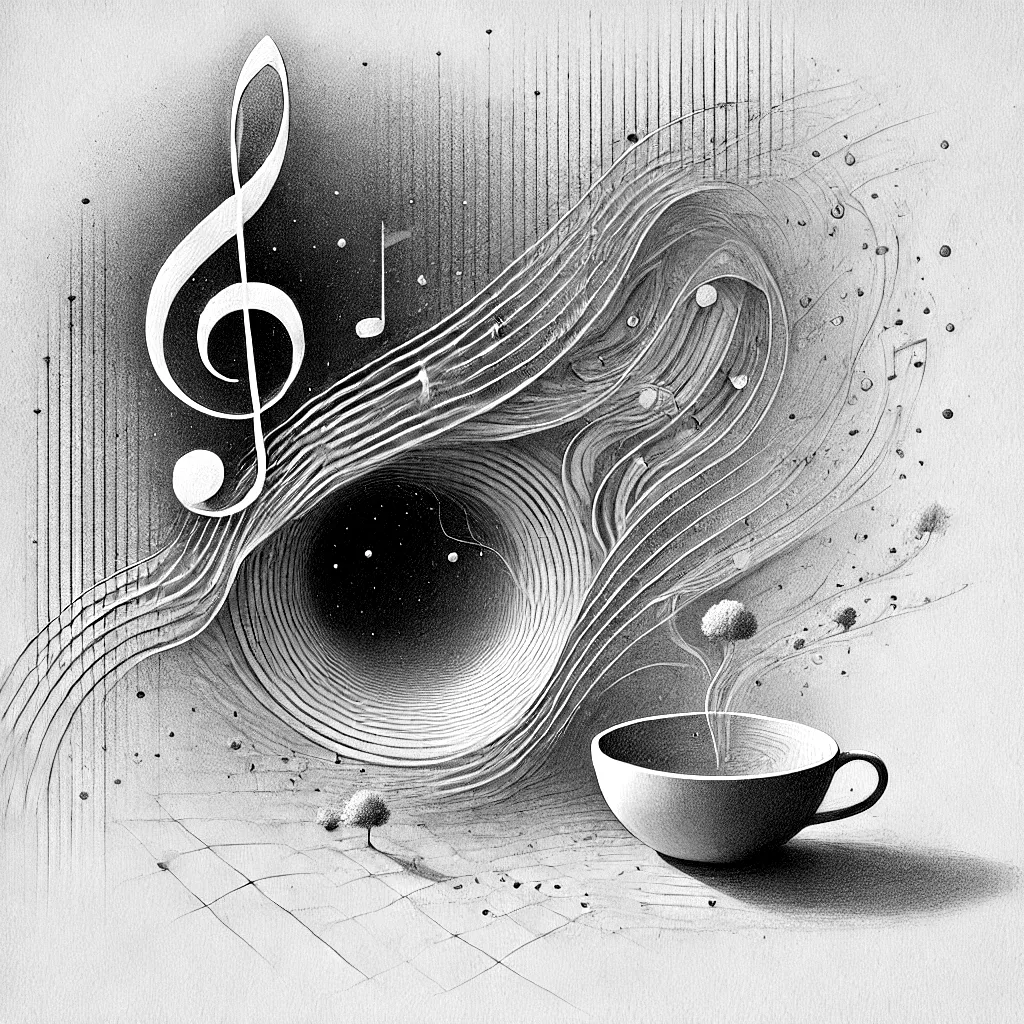
Symphony of Absence
A bowl. Turn it in your hands. The clay is cool. The glaze is cracked with age.
Beautiful — but not the point.
The point is the hollow.
The cupped nothing that makes the bowl a bowl. Without its absence, this is a stone.
In music, we hear the notes. But music lives in the rests — the unsung intervals where anticipation tightens and the ear leans forward into silence and finds, there, the ache that melody alone could never carry. Beethoven knew. His pauses do more work than his fortissimos. The sound is the scaffolding. The silence is the cathedral.
Every love that has ever mattered lives in its rests too. The unspoken hours. The note not played.
Your coffee cup sits half-empty on the desk. Steam rises and vanishes. Substance becoming ghost. Warmth dissolving into the cool morning air. The cup does not mourn its emptying. It waits. This is its quiet wisdom: the willingness to be filled, drained, filled again.
Beyond the window, the city breathes. Not in its towers and traffic, but in its parks, its alleyways, the strip of sky caught between buildings. These are the lungs of the place — the voids that keep density from becoming suffocation. A city without empty space is not a city. It is a tomb. The plaza where strangers pause. The bench where the old man reads. The vacant lot where children invent worlds from dirt and sticks. These nothings make a city live.
Pull back further. Past the atmosphere, past the moon, into the black. The cosmos is almost entirely empty. Silent. Ancient beyond reckoning. Yet this emptiness is not barren. It is the womb of stars. Every atom in your body was forged in a furnace that ignited because space gave fire room to burn. You are not surrounded by void. You are made by it. The dark between galaxies is the same dark between your atoms, and it hums with the same quiet potential.
This is the symphony we have been tracing. From bowl to breath. From cup to cosmos. Each absence composing the next. Each silence making room for the note that follows. Not a symphony of sound. A symphony of the spaces sound needs to become itself.
Emptiness is not a lack. It is a presence. The first and last note of everything that is, and everything still becoming.
This chapter unlocks on your own clock — based on the pace you chose. Sign up for the weekly note and we'll email it to you the moment it's ready.
One short note per week. The chapter that just unlocked, what comes next, and a line or two about why. Nothing else. Unsubscribe is one click.
Two physical editions are being considered. If enough readers say they'd want one, it gets made. If not, the book stays online and that is fine too.
Use the weekly-notes form above and tick the relevant boxes. That is the entire signal — no payment, no obligation, just a count.
If you want to commit to a reservation today (still no charge until shipping), the existing reservation form is also available.